못생김은 주관적인 거라고 생각해서 이 주제를 듣고 생각을 많이 했어요.I think ugliness is subjective, so I gave this topic a lot o… 2026.07.03 20:45:08 · Hyuk Jang auto-translated
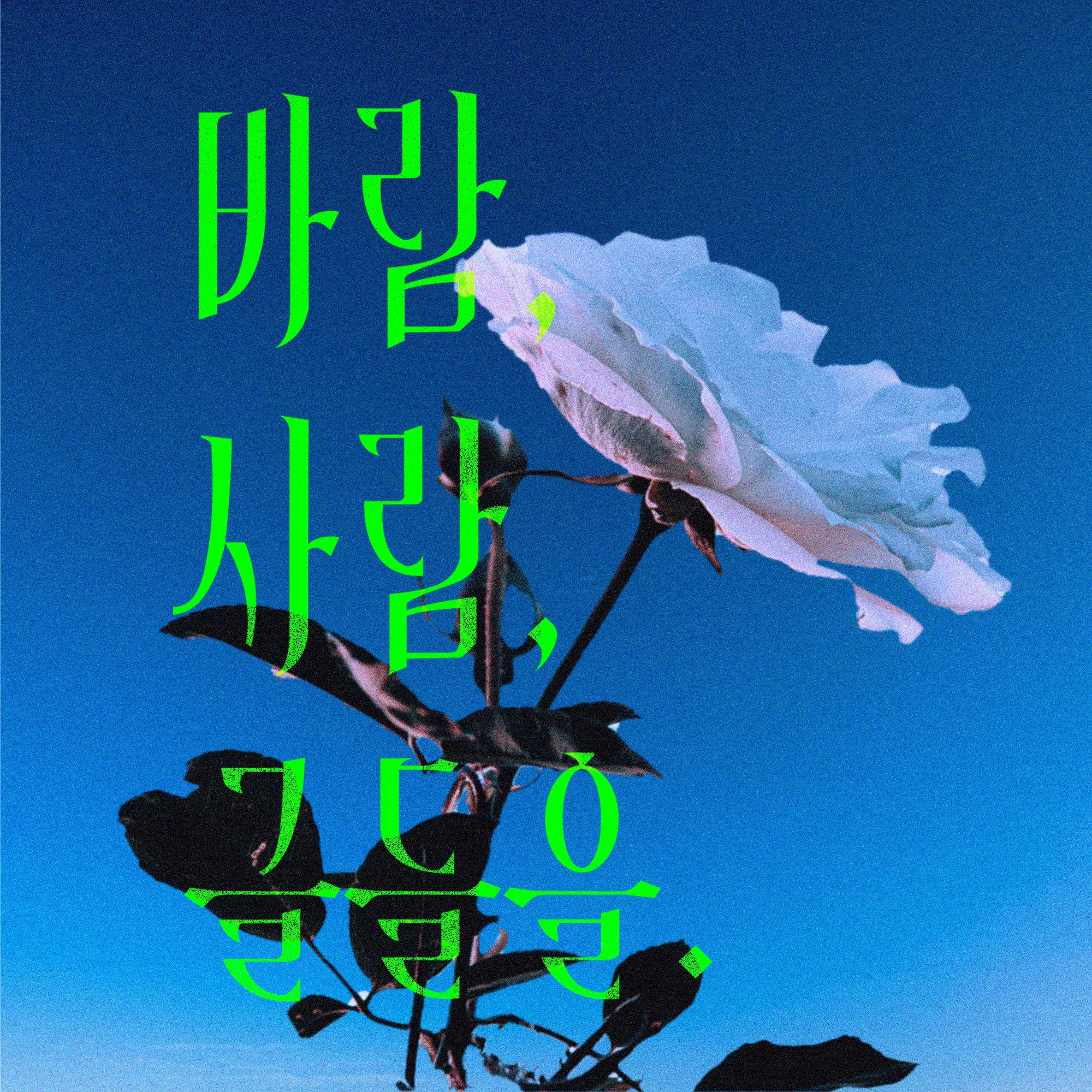
못생김은 주관적인 거라고 생각해서 이 주제를 듣고 생각을 많이 했어요. 내가 어떤 걸 예뻐하고 어떤 걸 못생겼다고 생각하는지… 이걸 생각해 보려면 과거로 올라가야 할 것 같아요. 제가 디자인과를 진학하기로 마음먹었던 19살, 20살, 그때쯤으로요. 저는 당시 네덜란드, 스위스 디자인에 매료되어서 많이 찾아보고 자라온 터라, 그런 디자인을 제외한 모든 것을 다 못생긴 거라고 생각했어요. 지금 생각하면 부끄럽죠. 그래서 동동님께서 말씀하시는 생각하지 않는 태도에서 나온 결과물도 못생겼을 수 있지만, 사람마다 예쁘다고 생각하는 것과 못생겼다고 생각하는 것이 기준이 달라서, 모든 것이 다 못생긴 것이 될 수도 있다고 생각해요. 모두 살아온 환경과 그동안 본 것들이 다르니까요. 어떤 사람은 내가 되게 좋아하는 걸 보고 못생겼다고 할 수도 있고, 어떤 사람은 내가 되게 싫어하는 걸 보고 예쁘다고 생각할 수도 있죠. 저희 셋 모두 못생겼다고 동의하는 지자체의 조형물이나 재단 웹사이트도, 누군가는 예쁘다고 생각할 수도 있어요. 그래서 못생긴 것은 주관적이라는 것을 우선 말씀드리고 싶어요. 그래도 굳이 이미지 생산자 입장에서 어떤 걸 ‘못생겼다’라고 느끼는지 솔직하게 말하자면, 욕망을 단순하게 들이미는 것들이에요. 주로 고급스러워 보이려는 혹은 아름다워 보이려는 욕망이죠. 남들과 위계를 나누려고요. 앞서 이야기한 웹사이트도 고급스러워 보이려는 욕망이 과해서 이상해진 것 같아요. 금색 그래디언트 같은 것이요. 유치한 것들도 못생겼다고 말할 수 있겠어요. 식당 같은 곳에서 “너는 고기 먹을 때 제일 예뻐”라는 문구가 네온사인으로 박혀 있는… 이런 것을 못생겼다고 느끼네요. 김국한I think ugliness is subjective, so I gave this topic a lot of thought. What do I find beautiful and what do I find ugly… To think about this, I think I need to go back in time. To when I was 19, 20 years old, around when I decided to pursue design. At that time, I was fascinated by Dutch and Swiss design, looked into them a lot, and grew up with them. So I thought everything except that kind of design was ugly. It's embarrassing to think about now. So the results that come from the kind of thoughtless attitude Dongdong mentions could also be ugly, but I think that because each person has different standards for what they find beautiful and what they find ugly, everything could end up being ugly. Because everyone has lived in different environments and seen different things. Some people might look at something I really like and think it's ugly, and some people might look at something I really dislike and think it's beautiful. Even the public sculptures or foundation websites that all three of us agree are ugly—someone out there might think they're beautiful. So I want to first say that ugliness is subjective. But if I'm going to be honest about what I, as an image maker, feel is "ugly," it's things that simply push forward simple desires. Mainly the desire to look luxurious or beautiful. To create a hierarchy with others. The website I mentioned earlier seems to have become strange because the desire to look luxurious is excessive. Like gold gradients. I could also say childish things are ugly. Like in restaurants where "you look the most beautiful when you're eating meat" is stuck up in neon—I find things like this ugly. Kim Guk-han↗ are.na/block/47548711

누군가에게는 웹사이트는 웹사이트일 뿐이지만, 웹사이트는 또 다른 공간입니다.For some, a website is just a website, but a website is anot… 2026.07.03 09:46:52 · Hyuk Jang auto-translated
누군가에게는 웹사이트는 웹사이트일 뿐이지만, 웹사이트는 또 다른 공간입니다. 처음에는 작품에서 시작합니다. 작품을 모으고 정리하기 위해 공간이 만들어지죠. 하지만 공간을 가꾸다 보면 언젠가부터는 공간을 채우고픈 욕망에 이끌려 작품을 만들게 될지 모릅니다. 그게 웹사이트라는 공간이 지닌 생산적 즐거움입니다. 민구홍 (출처: 단수도 복수도 아닌 플랫폼: 비평가의 웹사이트)For some, a website is just a website, but a website is another space. It starts with works. A space is created to collect and organize those works. But as you cultivate the space, you may at some point find yourself creating works driven by the desire to fill it. That is the productive pleasure that the space of a website possesses. Min Goo Hong (Source: A Platform That Is Neither Singular Nor Plural: The Critic's Website)↗ are.na/block/47537585

메타포는 두 가지를 가져야 한다: ==원래 이미지와 변환되는 이미지 사이의 감각적(시각, 텍스처, 소리 등)…metaphors should have two things: ==sensory (visual, texture… 2023.11.04 05:21:07 · ♡₊˚roshni ⭒˚。𓂀 자동 번역
메타포는 두 가지를 가져야 한다: ==원래 이미지와 변환되는 이미지 사이의 감각적(시각, 텍스처, 소리 등) 연결==과 함께 명확한 ==두 이미지 간의 논리적 연결==이 있어야 한다. 둘 중 하나만 있다면 메타포를 포기하는 것이 낫다. 그렇지 않으면 억지스럽거나 "글쓰기"처럼 읽힐 것이다. [...] 본질적으로 망가진 메타포는 "문학적" 또는 "시적"이 되고 싶다는 성급한 욕망을 신호한다(즉 "글쓰기*"), 이는 독자와의 공감을 잃을 수 있다. 다시 말해, 메타포는 우회로지만 그 우회가 ==이미 거기에 있는 것의 의미를 발견하고 증폭시키는== 곳으로 이어져야 한다. 그래야 독자가 너를 가능성의 종복으로 보지, "작가"라는 것을 증명하려는 누군가로 보지 않는다. 하나는 표현적이고, 다른 하나는 탐구적이다. 이런 식으로 메타포는 가상의 매체처럼 작용하여 텍스트의 광학적 사실성을 "다른 곳"으로 내보낸다. 그러나 이 다른 곳은 우리가 돌아올 때 원래 것을 알려줘야 한다. 그렇지 않으면 그 여정은 충돌에서 튕겨 나가는 것처럼 느껴질 것이지, 더 복잡한 의미로 향하는 선별된 여정처럼 느껴지지 않을 것이다. 예시: _"길이 고양이 꼬리처럼 굽어있다."_ 이건 약한 메타포다. 왜냐하면 변환되는 이미지(꼬리)가 원래 것을 증폭하거나 변화시키지 않기 때문이다. 의미의 이전이 평탄해지고 죽어간다. 논리가 약하거나 무관하다: 고양이 꼬리는 길의 본질을 정말로 바꾸지 않는다. 물론 이것을 몇 가지 설명적 문장으로 추가할 수 있지만, 그때쯤이면 넌 그냥 메타포에 심폐소생술을 하고 있는 것이다. 감각적으로도 약하다: 고양이 꼬리는 굽어있다는 것 외에는 길과 시각적으로 거의 닮지 않았다(길은 털이 없으니까). 그래서 이건 0 대 2이고 폐기되어야 한다(물론 내 의견일 뿐이다! 규칙은 아니다!). 그럼 이건 어떨까: _"길이 두 소나무 숲 사이를 흐르듯이, 삭발머신을 처음 올렸을 때처럼."_ 이건 낫다. 변환되는 이미지(머리를 가르는 클리퍼)의 광학적 감각이 원래 것과 잘 맞는다. 하지만 논리가 자의적으로 느껴진다. 다시 말해 원래 것을 본질적으로 변화시키지 않는다. 결국 이건 그냥 "흥미로운 이미지"일 뿐 충분히 강하지 않아서 보관할 가치가 없다고 나는 생각한다. 이제 Sharon Olds의 작품을 보자: _"나의 아버지의 팔 위의 머리카락이 당밀 칼날처럼."_ 감각적 연결: 확인. 남자의 검은 머리카락은 정말로 칼날처럼(풀을 시사하기도 함) 당밀처럼 보일 수 있다. 논리적 연결: 확인. 아버지는 날카롭고 동시에 달콤하다. 한때 부드럽고 끈기 있던 무언가(젊음의 암시), 단것이 이제 딱딱해졌다—그 과자는 더 이상 신선하지 않다 등등. 이건 야심 찬 메타포로 공명으로 가득 차 있다. 다시 말해, 그것은 엄청난 일을 하고 그것을 더 가지고 놀면 놀수록 더 깊어진다. 실제로 독자를 초대하는 메타포—책을 내려놓고, 그것에 대해 생각하고, 흡수한 뒤 돌아오도록. 좋은 메타포는 우회로를 사용하여 텍스트에 힘을 더한다. 나쁜 메타포는 텍스트에서 주의를 돌리고 널 고아 상태로 남겨둔다. 마지막으로, 앞의 예들은 기술적으로는 "직유"이지만 나는 직유가 메타포의 우산 아래 있다고 믿는다. 비록 직유는 구분 기호—즉, 이것은 "저것처럼"이다—이지만 "이것은" 본체적으로 그것이 아니다. 그러나 나는 읽는 행위에서 뭔가가 일어난다고 생각한다. 우리는 "다리"를 무너뜨리고 마음이 자동으로 두 이미지 사이에 시너지를 만든다. 그래서 모든 직유는 읽혀지면 메타포처럼 "작용"한다. 하지만 다시, 이건 모두 주관적이다. 넌 더 나은 방식을 가질 수도 있다. 또 다른 매우 야심 찬 메타포는 Eduardo C. Corral의 이것이다: _"이끼가 나무를 타며 심해지니, 박수 같다."_ 이건 주인공 격의 메타포로, 위험하고 많은 신념, 절제, 경험이 필요하다. 주로 어려운 이유는 이제 감각 영역의 초현실주의적 "왜곡"을 본다는 것이다: 원래 이미지(이끼)가 변환되는 음향(박수)과 짝을 이룬다. 비교 가능한 요소에 도약이 있다. 하지만 우리의 두 가지 중요한 요소에 대한 준수는 여전히 존재한다. 감각적: 이끼는 침묵하지만 천천히 자란다("심해진다"는 단어는 주요 작업을 한다. 왜냐하면 변환되는 요소를 미리 암시하기 때문이다). 박수도 마찬가지로 서서히 커지다가 죽어간다. 논리: 이끼의 성장은 봄, 풍요, 생명, 회복력을 암시하고 기대의 희망을 암시한다—박수처럼. 차례로, 박수는 이끼의 성질을 변화시키고, 최소한 이 이끼에, 성취감, 폐막, 그것의 새로움이 축하할 만한 원인이라는 의미를 부여한다. 신이여, 나는 단어를 사랑한다. [...] 나는 며칠 전 Q&A에 대한 내 답변이 즉흥적이었던 것 때문에 잠깐의 시간을 내고 있다(나는 내 미용실 약속으로 걸어가면서 입력했다). 내가 제안하는 것은 물론 이론일 뿐이고, 복음서가 아니므로 유용한 것은 가져가고 아닌 것은 무시해 달라. [...] 시작하기 전에 나는 모두에게, 특히 BIPOC 예술가라면 당신의 작업과 삶을 위한 당신만의 이론과 실천을 구축하도록 권장한다. 종종 우리는 기존의 권력에 의해 단순히 "공연자"로 인식된다—무대에서 (짧은) 출연에 적합하지만 우리만의 자율성, 지능, 그리고 우리 분야의 틀에 질문할 능력을 가진 사상가이자 창작자가 아니라고 본다. 미국에서 노란 몸으로서 나에게는, 그것이 지닌 거짓 암시들과 함께, 자주 왜소하고, 조용하고, 친절하고, 동의하는, 종속적인 것으로 보일 때, 현상에 맞서 생각하기, 내 예술과 삶의 실천 방식에 대한 내 고유의 이론을 가지기를 기대하지 않는다는 것이 나에게 스쳐가지 않는다. 나는 아티스트가 되기로 결심했고, 그것은 내가 미술이라는 분야(좋은 얼굴들이 몇 개 없는 분야)에 들어가고 있음을 알고 있었고, 그 분야에서는 우리가 바이올린이나 첼로를 집어 들고 유로중심의 "걸작"에 봉사할 때만 성공하기를 기대한다. 오랫동안, 아시안 아메리칸 미술의 "신동"이 되는 것은 모차르트, 바흐, 베토벤을 위해 미세 조정된 악기가 되는 것이었다. 그러니까 놀랍지도 않다—만약 넌, BIPOC 예술가로서, 감히 너 자신의 아이디어를 생각해내고, "아니오"라고 말한다면, 그들이 그토록 오랫동안 너의 목에 밀어 넣은(및 계속 밀어 넣은) 것에 대해, 넌 유아화될 것이고, 어리석고, 신경쓰지 않고, 불순종하고, 무교육이고, 길들여지지 않은 것으로 보일 것이다. 왜냐하면 그것은 한때 그들의 "작품"에 봉사했던 악기가 이제 말을 시작했다는 것을 의미하기 때문이고, 그들에게는 불가능하다는 것을 결정했기 때문이다. 자신의 노래를 부르기로 결정했기 때문이다. 나는 넌 나와 함께 노래하길 원한다. 나는 넌 단지 우리일 때 어떻게 들리는지 듣고 싶다, 그리고 넌 너 자신처럼 들려서 나는 너를 어두운 방에서도 알아본다, 내가 다른 것을 인식하지 못해도. 그리고 나는 넌 "작은 형제" 또는 "큰 자매," 또는 "광선," 또는 "내 울음이 내게 온전하게 돌아왔다"라는 이름을 가지고 있다고 알고 있다. 그리고 나는 미소 짓는다. 어둠 속에서 나는 미소 짓는다. 예술에는 규칙이 없다—그렇다—하지만 각 개인마다 다른 방법이 있다. 다음은 내 자신의 방법들과 내가 그것들에 어떻게 왔는지이다. 넘들이 직유법을 좋아하는 것에 매우 행복하다! 그것은 내가 가장 좋아하는 문학 장치다. 왜냐하면 그것은 비교를 통해 객체 또는 추상화 뒤의 두 번째 아이디어를 드러내기 때문이다. 잘 다루어지면, 그것은 내가 "보기의 DNA"라고 부르는 것을 만든다. 즉, ==강한 메타포(그리스어로 "옮기다")는 시각의 자서전을 실행할 수 있다.== 예를 들어, 밤하늘의 별을 출구상처로 보는 사람에 대해 그것이 무엇을 말하는가? 그것이 그들의 역사, 그들의 세계관, 미와 폭력에 대한 그들의 관계에 대해 무엇을 말하는가? 비교 요소들이 강하고 다면적인 결합을 가질 때 맥락 없이 메타포 자체에서 모든 것이 수집될 수 있다. ==우리가 세계를 어떻게 보는지는 우리가 누구인지를 보여준다. 그리고 메타포는 그 시각을 설명한다.== 내 개인적인 느낌은 가장 강한 메타포는 명확성을 위해 맥락을 필요로 하지 않는다는 것이다. 그러나 이것은 명확성이 필요한 더 약한 메타포가 쓸모없거나 잘못되었다는 의미는 아니다. 약한 메타포는 명확성을 달성하기 위해 맥락을 사용한다. 강한 메타포는 이미 명확한 것을 지원하기 위해 맥락을 사용한다. 둘 다 어느 문학 텍스트에서나 가능하다. 하지만 메타포와 그들의 단계에 대한 이 더 깊은 탐구의 목적을 위해, 나는 후자를 식별하려고 시도할 것이다. 나는 작가가 더 약한 버전이 다른 수단을 통해 같은 목표를 달성할 수 있을 때에도 그들이 사용하는 장치의 강점을 이해하는 것이 중요하다고 느낀다. 때때로 우리는 구명뗏목을 원하고, 때때로 우리는 증기선을 원한다—하지만 우리는 어느 것이 어느 것인지를 알아야 한다(우리를 위해). 내 초점은, 그러면, 특별히 장식적이거나 노골적인 메타포에 있을 것이다. 즉, 개념적, 주제적, 확장된 메타포 또는 호메릭 직유(완전히 다른 동물)와 반대로 라인 내에서 발생하는 메타포. 내 생각은 여기서 (논쟁의 여지가 있는) 이론으로 시작한다: 직유는 메타포 아래에 있다. 즉, (호메릭이 아닌) 직유는 인지적으로 메타포처럼 작동한다. 이것은 직유가 중요하지 않다는 의미가 아니다(멀리서도), 비교된 요소들이 읽혀지면 마음 속에서 병합되기 시작한다는 것을 의미한다. 그 결과 직유 수단을 통한 메타포 발생이 생긴다. 이 생각은 전적으로 내 자신은 아니지만, 현상학에 대한 나의 관심에 의해 알려진 것이다. 20세기 초 Edmund Husserl에 의해 설립되고 나중에 Heidegger에 의해 확장된 현상학은, 간단히 말해, 객체 또는 현상이 마음에서 어떻게 인식되는지에 관심이 있고, 계몽의 절대적이고 유한한 진리에 대한 추구와 달리, 유럽 전역의 주관성에 새로운 관심을 가져왔다. 그러나 Husserl이 이것을 "발견"했을 시간쯤, 티베탄 불교 학자들은 이미 Lojong, 또는 "마음 훈련"이라고 불리는 것으로 현상학을 5백년 이상 실행하고 있었다. Husserl은 부분적으로 유한한 진리가 존재하지만 인간 인식의 근시안적 성질이 우리가 그것의 전부를 보는 것을 방해한다고 믿는 반면, 티베탄 Lojong은 유한한 "진리"가 전혀 존재하지 않는다고 주장한다. Lojong에서, 세계와 그것의 객체는 순수한 인식이다. 즉, 파리가 나무를 보면, 그것의 복잡한 눈 때문에, 수백 개의 나무를 본다. 반면 우리는 하나만 본다. 불교도들에게, 파리든 인간이든 "옳은" 것이 아니다. 왜냐하면 고정된 진리가 존재하지 않기 때문이다. 현실은 오직 개인의 신체 매개체에 따라서만 현실이다. 나는 Lojong의 접근법에 깊은 관심을 가지고 있다. 왜냐하면 그것은 내재적으로 세계의 탈식민지 응시를 옹호하기 때문이다. 실제의 객체가 지속될 수 없다면, 그들이 획득되고, 정복되고, 약탈되어야 할 이유가 없다. 다시 말해, 우리는 "시뮬레이션"에 있고 유일한 환상인 무언가를 획득하는 것에서 진정한 이득이 없기 때문에, 이 세계를 지나가는 손님으로 현상을 관찰하고 배우고 사물에 대한 존경의 태도로 행동하는 것이 낫다. 내가 이것을 언급하는 이유는 불교 철학이 8세기 중국과 15-17세기 일본 시가에 주요 영향을 미쳤기 때문이고, 그것이 메타포에 대한 내 이해를 근본적으로 알려주기 때문이다. 나는 Aristotle의 메타포와 그의 시학(Poetics)에서의 수사학에 대한 견해를 높이 평가한다. 특히 그의 논제는 강한 메타포가 종에서 속으로 이동한다는 것이다. 그러나 그것은 내 생각에 강력한 영향을 미치지 않는다. 결국, 섹스와 물처럼, 메타포는 오래전에 인류에게 향유되었고, Aristotle 이후에도 명백히 향유되었다. 실제로 광범위하게 메타포와 유추를 사용하는 불교 교리는 Aristotle보다 약 150년 전에 시작된다. 이제 불교 현상학이 이미지의 메타포로의 변환에 어떻게 영향을 미치는지를 더 잘 보기 위해, Moritake의 이 시를 보자. _"떨어진 꽃이 가지로 날아간다._ _아니다, 나비다."_ (서양이 지배하는) "like"나 "is"를 사용하는 유추에 대한 담론을 고려할 때, 이 이미지는 메타포인가 또는 직유인가? 기술적으로는 둘 다 아니다. 이 시의 구성은 메타포나 직유를 사용하지 않는다. 그리고 아직도, 내 눈에는, 비록 존재하지 않지만, 메타포가 실제로 일어난다. 더욱이, 이 시는 본질적으로 하나의 메타포로, 완성되어 있다. 명확성을 위해 더 이상의 맥락이 필요하지 않다. 만약 맥락이 메타포에 필요하다면, 그 메타포는 (내 의견으로는) 약하지만 그것이 전체 글쓰기가 나쁘다는 의미는 아니다. 약한 메타포와 좋은 맥락이 우리를 안전하고 건전하게 집으로 데려다준다. 좋아, 그럼 여기서 뭐가 일어나고 있는가? 내가 "나비"를 읽을 시간쯤이면 내 마음이 꽃을 수정하므로 후자의 이미지가 소급하여 전자를 변화시키고/알린다. 우리는 꽃이 떠오르는 것을 보고, 나비로 다시 본다. 메타포적 형상화가 완성된다. "like"나 "is" 없이도. 불교는 이것을 설명한다. 비록 텍스트가 사상이지만 그것이 생각하지 않는다고 말함으로써. 우리, 독자들이 그것을 생각해야 한다. 그러면 텍스트는 사상을 세심하게 기획한다. 단어는, 이런 식으로, 페이지에서 시작하지만 인간 인식의 제한되고 주관적인 범위 때문에 마음 속에서 산다. 고정된 것으로 보이는 요소들을 완전히 새로운 것으로 이동한다. 여기서 핵심은 근접성이다. 직유는 두 요소 사이의 충격을 조정하기 위한 완충장치를 제공하지만, 그들이 읽을 때 이미지들이 어떻게 일치하는지를 지배하지 않는다. ==페이지에서, 텍스트는 화석이다; 마음에서, 텍스트는 생명이다.== Maritake가 온 지 거의 500년 후, Ezra Pound는 Fenolosa를 통해 Maritake의 시를 읽고, 1912년에 이미지주의의 기초가 되는 시를 쓰는데, 이것은 이후로 초기 모더니스트들에게 큰 영향을 미쳤다: _"군중 속에 이 얼굴들의 출현:"_ _"검은 젖은 가지 위의 꽃잎들."_ Maritake처럼, Pound의 시는 기술적으로 메타포나 직유가 없다. 그러나 그는 "crowd," 뒤에 중요한 콜론을 추가한다. 이것은 "같음 기호"로 작동하여, 메타포를 암시한다. 하지만 그가 "are"나 "is"를 사용하지 않은 이유는 의미심장하다. Pound는, Maritake처럼, 이미지들의 가까운 근접성 때문에 연결 동사 없이도 메타포가 마음에서 일어날 것을 이해했다. 우리는 이것을 "연상"으로 알게 될 것이다. 콜론이 "like"라는 단어로 대체되었어도, 변환은, 좀 더 느리겠지만, 여전히 일어날 것이다. 사실, 내가 몇 년 전에 Pound를 처음 공부했을 때, 이 시가 직유로 형성되었는지 아닌지 기억하기가 힘들었던 이유는 주로 내가 시를 회상하려고 할 때마다 얼굴이 완전히 꽃잎으로 변하기 때문이다. 이제, 앞에서 본 Eduardo C. Corral의 라인에서처럼 위의 예들과 같은 방식으로 메타포화되는 직유를 보자: _"나무 위의 이끼가 심해지니, 박수 같다."_ 원래/운률 이미지(이끼)는 변환되는 요소인 (박수)에 연결된다. 이 메타포는 광학적 관계가 아니라 행동적 관계를 제안한다. 이끼도 박수도 모두 특이점을 통해 축적되는 덩어리다: 이끼 입자들과 박수치는 손 쌍들이 더 큰 전체를 형성한다. 이 둘을 비교함으로써, Corral은 이끼가 박수의 속도로 자란다는 것을 성공적으로 제안한다. 박수는 이끼 성장을 가속하고, 소생, 기쁨, 새로움을 암시한다. 이끼처럼 평범한 것이 심지어 축하를 받을 자격이 있다는 것은 또한 alterity의 강력한 진술을 제공한다. 가장 작은 번영이 축하를 받을 자격이 있고, 이는 차례로 헤게모니에 대한 미묘하지만 강력한 정치적 비판을 제안한다. 시인은, 메타포를 통해, 객체(이끼)에 배치된 전통적 가치 모드를 재정정했다. 그리고 그것을 보기 위해 다른 맥락이 필요하지 않다. 넌 동의하지 않을 수도 있지만, 내가 Corral의 라인을 읽을 때, 나는 청중이 이끼 옆에서 박수를 치는 것을 보지 않는다. 나는 박수 소리로 빠르게 자라는 이끼를 본다. 비록 직유가 사용되었지만, 두 요소의 융합이 내 마음의 눈에서 액션을 완성한다. Maritake와 Pound처럼, 메타포가 일어났다—하지만 "메타포" 없이. 그러나, 직유는 여전히 중요하다. 왜냐하면 변환되는 요소가 추상적이고(박수) 이끼처럼 보이지 않기 때문이다. 우리는 이끼가 박수가 되기를 원하지 않는다. 우리는 박수의 본질이 이끼를 알려주고, 스며들기를 원한다. 내 생각에는 이 라인이 직유 없이 형성되었다면 매우 나쁠 것이다: _"옥의 이끼는 나무 위의 박수다."_ "is"는 전환을 강제한다. 여기서는 중재 없이 두 가지를 함께 내려치는 것과 같다. 우리는 또한 행동의 비교를 잃고, 이끼가 박수가 되기를 봐야 한다. 이것은 원래 것과 같은 의미를 가지지 않는다. 그래서, 비록 직유가 메타포로 융합되지만(연상을 통해) 마음 속에서, 그러한 메타포는 직유 없이는 가능하지 않았을 것이다. 직유는 메타포를 향한 도구로서 크게 중요하다. 왜냐하면 (감사 신이여) 우리의 마음은 배회하기에 자유롭기 때문이다. 요약하면, 일본 하이쿠의 중심 전략 중 하나(그리고 어느 정도는 목적)는 두 요소를 나란히 배치하여 그들의 시너지를 시험하는 것이다. 이 충동은 신토와 불교의 무상(無常)과 구조적 가변성의 개념에 뿌리를 두고 있다. 즉, 모든 것은 심지어 아이디어와 이미지도 상수 변화의 대상이고, 그러한 변화는 인식의 가장 광범위한 성질이다. 하이쿠는 그러면 그러한 변화를 시험하기 위한 완벽한 매체가 된다. 이 원칙은 나에게 중요하다. 왜냐하면 그것은 비이원적(또는 비이진) 사고에 근거하기 때문이다. 시는 고정된 요소를 변환할 수 있고, 그들의 경계는 용해 대상이고, 완전히 새로운 것으로 이동할 수 있는 극장이 되는데, 이것은 시인의 단어인 "시인하다"의 그리스어 근원이다. 메타포는, 그러면, 화학적 요소처럼 더 많다. 그 요소들(수소와 산소처럼)을 나란히 배치하면, 물이 된다. 이런 식으로, 불교가 내 일에 미치는 영향과, 특히 메타포에 대한 내 사용과 이해는, alterity의 근본적인 퀴어 실천이다. 내가 직유의 영향의 가변성을 강조하는 이유는, 비록 문법과 단어 선택이 메타포를 그것의 더 밝은 구현으로 도움을 줄 수 있지만, 그것의 성공의 궁극적인 핵심은 넌, 관찰자라는 것이다. 넌 깊이 보고 이질적인 세계의 것들 사이에서 지속적인 관계를 찾아야 한다. 이런 의미에서, ==메타포의 실천은 또한, 내가 믿기로는, 연민의 실천이다. 내가 어떻게 무언가를 공부하여 그것에 다른 무언가를 소개함으로써 그것의 생명에 추가할 수 있을까?== 최고에서, 메타포는 우리가, 인류로서, 항상 해온 것이다. 우리의 최고일 때: 뭔가 또는 누군가를 가리키는 것—우리로부터 너무 다르고, 우리의 기원에서 너무 멀리서—그리고 말하는 것. "그렇다, 우리 사이에는 유대가 있다. 그리고 충분히 오래, 충분히 열심히 일하면, 나는 이 언어라고 불리는 것—이 것이 무게가 없지만 내 마음에 모든 것을 의미하는—으로 그것을 증명할 수 있다." 결국, 그것은 너가 어떻게 메타포를 설정하느냐에 대한 것이 적다(결국 넌 그것에 맞는 방법을 찾을 것이다)—그보다는 어떻게 넌 너의 세계를 인식하느냐에 대한 것이다. 그것은 쉽게 가르칠 수 없다—그것은 참을성 있는 실천에, 때때로 너무 고통스러워서 보기 힘들 수 있는 세계에 대한 헌신된 경이로움과 함께 온다. 하지만 넌 반드시 봐야 하고 봐야 한다. 결국 좋은 메타포는 이미 거기에 있는 것 너머를 보려고, 다른 가능성을 향해 헌신된 작가로부터 온다. 이것은 넌 너의 삶과 일을 발견의 무진함 장소로 보고, 넌 경의와 함께 그것들을 돌보도록 요청한다. 그것뿐이다. 그것이 ==강한 메타포의 진정한 비결이다: 돌봄.== 마지막으로, 나는 BIPOC 시인이자 이론가인 Thylias Moss의 일을 추천하고 싶다. 그녀는 제한된 포크 이론을 발견했다. 이 이론은 마음이 세계와 어떻게 관계되는지, 그리고 특히 아이디어와, 텍스트와 예술을 포함해서, 포크의 다리가 식판과 어떻게 관계되는지를 제안한다. 즉, 각 시도마다 포크/마음에 보관할 수 있는 것은 많아야 하고, 어떤 "일"도 전체로 소유될 수 없다. 나는 이것이 Lojong과 행복하게 일치한다고 생각한다. 우리의 행성과 그것의 현상과 관계되는 그런 멋진 제국주의-반대이고 용서하는 방법이다. 감사합니다, Moss 부인! 그리고 감사합니다 내 작은 세미나를 통해 머물러 준 너에게. 나는 이것이 도움이 되었으면 한다. 다시, 이건 내 2(5)센트일 뿐이다! 이제 나는 4일 동안 자려고 간다. 그동안, 메타포가 넘과 함께 있기를. —Ometaphors should have two things: ==sensory (visual, texture, sound, etc) connector== between origin image and the transforming image as well as a clear ==logical connector between both images==. if you have only one of either, best to forgo the metaphor. otherwise it will seem forced or read like "writing" if that makes sense. [...] essentially, metaphors that go awry can signal a hurried desire to be "literary" or "poetic" (ie "writing*"), which can lose traction/trust with a reader. in other words, a metaphor is a detour/but that detour better lead to ==discoveries that alter/ amplify the meaning of what is already there==, so that a reader sees you as a servant of possibility rather than someone trying to prove that they are a "writer." One is performative, the other exploratory. In this way, the metaphor acts as a virtual medium, ejecting the text's optical realism into an "elsewhere". But this elsewhere should inform the original upon our return. otherwise the journey would feel like an ejection from a crash rather than a curated journey toward more complex meaning. example: _"The road curves like a cat's tail."_ This is a weak metaphor because the transforming image (tail) does not amplify/ alter the original. The transfer of meaning flattens and dies. Logic is weak or moot: A cat's tail does not really change the nature of the road. You can certainly add to this with a few more expository sentences which might rescue the logic but by then you're just doing cpr on your metaphor. Sensory, too, is weak: a cat's tail has little optical resemblance to a road other than being curved (roads are not furry, for one.) So this is 0 for 2 and should be scrapped (Just my opinion though! Not a rule!) okay so what about: _"The road runs between two groves of pine, like the first stroke of a buzzcut."_ this is better. the optical sensory of the transforming image (a clipper thru a head of hair) matches well with the original. but the logic feels arbitrary. again it doesn't substantially alter the original. in the end this is just an "interesting image" but not strong enough to keep I’d say. Now here's one from Sharon Olds: _"The hair on my father's arms like blades of molasses."_ Sensory connector: check. A man's dark hair indeed can look like blades (also suggestive of grass) of molasses. Logical connector: check. the father is both sharp and sweet. Something once soft and sticky about him (connotations of youth) sweets, has now hardened the confection no longer fresh etc. It's an ambitious metaphor that is packed with resonance. In other words, it does worlds of work and actually deepens the more you dit with it. A metaphor that actually invites you to put the book down, think on it, absorb it, before returning. a good metaphor uses detours to add power to the text. poor metaphors distract you from the text and leave you bereft, laid to the side. lastly, the prior examples are technically "similes" but I believe similes reside under the umbrella of metaphor. although a simile is a demarcation, ie: this is "like" that. but this is "not", ontologically, that. however, I think something happens in the act of reading wherein we collapse the "bridge" and the mind automatically forges synergy between the two images, so that all smiles, once read, "act" like metaphors in the mind. but again this is all subjective. you might have a better way of going about it. Another very ambitious metaphor is this one from Eduardo C. Corral: _"Moss intensifies up the tree, like applause."_ This is a masterful metaphor, risky and requires a lot of faith, restraint, and experience to pull off. Difficult mainly because now we see a surrealist "distortion" of the sensory realm: origin IMAGE (moss) is paired with transforming SOUND (applause). There is now a leap in comparable elements. But the adherence to our two vital factors are still present. Sensory: moss, though silent, grows slowly (the word "intensifier" does major work here becuz it forshadows the transforming element). Applause, too, grows gradually, before dying down. Logic: the growth of moss suggests spring, lushness, life, resilience and connotes anticipatory hope, much like applause. In turn, applause modifies the nature of moss and imbues, at least this moss, with a sense of accomplishment, closure, it's refreshment a cause for celebration. God I love words. [...] I'm taking a moment here to do a more in-depth mini essay since my answer to the Q/A the other day was off the cuff (I was typing while walking to my hair cut appointment.) What I'm proposing, of course, is merely a THEORY, not a gospel, so please take whatever is useful to you and ignore what isn't. [...] Before I begin I want to encourage everyone to forge your own theories and praxi for your work, especially if you're a BIPOC artist. Often, we are perceived by established powers as merely "performers," suitable for a (brief) stint on stage but not thinkers and creators with our own autonomy, intelligence, and capacity to question the framework in our fields. It is not lost on me, as a yellow body in America, with the false connotations therein, where I'm often seen as diminutive, quiet, accommodating, agreeable, submissive, that I am not expected to think against the grain, to have my own theories on how I practice my art and my life. I became a writer knowing I am entering a field (fine arts) where there are few faces like my own (and with many missing), a field where we are expected to succeed only when we pick up a violin or a cello in order to serve Euro-Centric "masterpieces." For so long, to be an Asian American "prodigy" in art was to be a fine-tuned instrument for Mozart, Bach, and Beethoven. It is no surprise, then, that if you, as a BIPOC artist, dare to come up with your own ideas, to say "no" to what they shove/have been shoving down your throat for so long, you will be infantilized, seen as foolish, moronic, stupid, disobedient, uneducated and untamed. Because it means the instrument that was once in service of their "work" has now begun to speak, has decided, despite being inconceivable to them, to sing its own songs. I want you, I need you, to sing with me. I want to hear what you sound like when it's just us, and you sound so much like yourself that I recognize you even in the darkest rooms, even when I recognize nothing else. And I know your name is "little brother" or "big sister," or "light beam," or "my-echo-retuned-to-me-intact." And I smile. In the dark I smile. Art has no rules—yes—but it does have methods, which vary for each individual. The following are some of my own methods and how I came to them. I'm very happy ya'll are so into figurative language! It's my favorite literary device because it reveals a second IDEA behind an object or abstraction via comparison. When done well, it creates what I call the "DNA of seeing." That is, ==a strong metaphor (Greek for "to carry over") can enact the autobiography of sight.== For example, what does it say about a person who sees the stars in the night sky as exit wounds? What does it say about their history, their worldview, their relationship to beauty and violence? All this can be garnered in the metaphor itself without context when the comparative elements have strong, multifaceted bonds. ==How we see the world reveals who we are. And metaphors explicate that sight.== My personal feeling is that the strongest metaphors do not require context for clarity. However, this does not mean that weaker metaphors that DO require context are useless or wrong. Weak metaphors use context to achieve CLARITY. Strong metaphors use context to SUPPORT what's already clear. BOTH are viable in ANY literary text. But for the sake of this deeper exploration into metaphors and their gradients, I will attempt to identify the latter. I feel it is important for a writer to understand the STRENGTHS of the devices they use, even when WEAKER versions of said devices can achieve the same goal via different means. Sometimes we want a life raft, sometimes we want a steam boat—but we should know which is which (for us). My focus, then, will be specifically the ornamental or overt metaphor. That is, metaphors that occur inside the line- as opposed to conceptual, thematic, extended metaphors, or Homeric simile (which is a whole different animal). My thinking here begins with the (debated) theory that similes reside under metaphor. That is, (non Homeric) similes, behave, cognitively, like metaphors. This DOES NOT mean that similes do not matter (far from it), as we'll see later on, but that the compared elements, once read, begin to merge in the mind, resulting in a metaphoric OCCURRENCE via a simileac vehicle. This thinking is not entirely my own, but one informed by my interest in Phenomenology. Founded by Edmund Husserl in the early 20th century and later expanded by Heidegger, Phenomenology is, in short, interested in how objects or phenomena are perceived in the mind, which renewed interest in subjectivity across Europe, as opposed to the Enlightenment's quest for ultimate, finite truths. By the time Husserl "discovered" this, however, Tibetan Buddhists scholars have already been practicing Phenomenology as something called Lojong, or "mind training," for over half a millennia. Whereas Husserl believes, in part, that a finite truth does exist but that the myopic nature of human perception hinders us from seeing all of it, Tibetan Lojong purports that no finite "truth" exists at all. In Lojong, the world and its objects are pure perception. That is, a fly looks at a tree and sees, due to its compound eyes, hundreds of trees, while we see only one. For Buddhists, neither fly nor human is "correct" because a fixed truth is not present. Reality is only real according to one's bodily medium. I'm keenly interested in Lojong's approach because it inheritably advocates for an anti-colonial gaze of the world. If objects in the real are not tenable, there is no reason they should be captured, conquered or pillaged. In other words, we are in a "simulation" and because there is no true gain in acquiring something that is only an illusion, it is better to observe and learn from phenomena as guests passing through this world with respect to things—rather than to possess them. The reason I bring this up is because Buddhist philosophy is the main influence of 8th century Chinese and 15th-17th century Japanese poetics, which fundamentally inform my understanding of metaphor. While I appreciate Aristotle's take on metaphor and rhetoric in his Poetics, particularly his thesis that strong metaphors move from species to genus, it is not a robust influence on my thinking. After all, like sex and water, metaphors have been enjoyed by humans across the world long before Aristotle and evidently long after. In fact, Buddhist teachings, which widely employ metaphor and analogy, predates Aristotle by roughly 150 years. Now, to better see how Buddhist Phenomenology informs the transformation of images into metaphor, let's look at this poem by Moritake. _"The fallen blossom flies back to its branch._ _No, a butterfly."_ When considering (western-dominated) discourse surrounding analogues using "like" or "is", is this image a metaphor or a simile? It is technically neither. The construction of this poem does not employ metaphor or simile. And yet, to my eye, a metaphor, although not present, does indeed HAPPEN. What's more, the poem, which is essentially a single metaphor, is complete. No further context is needed for its clarity. If context is needed for a metaphor, then the metaphor is (IMO) weak but that doesn't mean the writing, as a whole, is bad. Weak metaphors and good context and bring us home safe and sound. Okay, so what is happening here? By the time I read "butterfly" my mind corrects the blossom so that the latter image retroactively changes/informs the former. We see the blossom float up, then re-see it as a butterfly. The metaphoric figuration is complete with or without "like" or "is.” Buddhism explains this by saying that, although a text IS thought, it does not THINK. We, the readers, must think upon it. The text, then, only curates thinking. Words, in this way, begin on the page but LIVE in the mind which, due to limited and subjective scope of human perception, shift seemingly fixed elements into something entirely new. The key here is proximity Similes provide buffers to mediate impact between two elements, but they do not rule over how images coincide upon reading. ==On the page, text is fossil; in the mind, text is life.== Nearly 5oo years after Maritake, Ezra Pound, via Fenolosa, reads Maritake's poem and writes what becomes the seminal poem on Imagism in 1912, which was subsequently highly influential to early Modernists: _"The apparition of these faces in the crowd:"_ _"Petals on a wet, black bough."_ Like Maritake, Pound's poem technically has no metaphor or simile. However, he adds the vital colon after "crowd," which arguably works as an "equal sign", thereby implying metaphor. But the reason why he did not use “are" or “is" is telling. Pound understood, like Maritake, that the metaphor would occur in the mind regardless of connecting verbiage due to the images' close proximity. We would come to know this as "association." Even if the colon was replaced by the word "like," the transformation, though a bit slower, would still occur. In fact, when I first studied Pound years ago, I had trouble recalling whether this poem was fashioned as a simile or not mainly because the faces change so fully into blossoms each time I try to recall the poem. Now, let's look at a simile that, to me, metaphorizes in the same way as the examples above, in the line we saw before from Eduardo C. Corral: _"Jade moss on the tree intensifies, like applause."_ The origin/tenor image (moss) is connected to the transforming element, (applause). This metaphor suggests, not an optical relationship, but a BEHAVIORAL one. Both moss and applause are MASSES that accumulate via singularities: grains of moss and pairs of hands clapping to form a larger whole. By comparing these two, Corral successfully suggests that moss grows at the RATE of applause, creating a masterful time lapse effect. Applause speeds up the moss growth, connoting rejuvenation, joy and refreshment. That something as mundane as moss deserves, even earns, jubilance, also offers a potent statement of alterity, that the smallest flourishing deserves celebration, which in turn suggests a subtle yet powerful political critique of hegemony. The poet, through the metaphor, has recalibrated the traditional modes of value placed on the object (moss). And no other context is needed to see that. You might disagree, but when I read Corral's line, I don't SEE an audience clapping BESIDE the moss. I see moss growing quickly to the sound of clapping. Although the simile is employed, the fusion of both elements completes the action in my mind's eye. Like in Maritake and Pound, metaphor has OCCURRED here—but without "metaphor". HOWEVER, the simile is still VITAL. Why? Because the transforming element is abstract (applause) and looks nothing like moss. We don't want moss to BE applause, we want the nature of applause to inform, imbue, moss. The line, I feel, would be quite poor if it was formed sans simile: _"Jade moss is applause on the tree."_ The "is" forces transposition, which is here akin to slamming two things together without mediation. We also lose the comparison of behavior, and are asked to see that moss BECOME applause, which doesn't have the same meaning as the original. So, although the simile fuses into metaphor (via association) in the mind, such a metaphor would NOT have been possible without the simile. Smilies matter greatly as tools towards metaphor. Why? Because (thank god) our minds are free to roam. To summarize, one of the central strategies (and, to an extent, purposes) of the Japanese Haiku is to juxtapose two elements to test their synergy. This impulse is grounded in Shinto and Buddhist concepts of impermanence and structural malleability. That is, all things, even ideas and images, are subject to constant change and such change is the most pervasive nature of perception. The Haiku then becomes the perfect medium to test such changes. This principle is of central importance to me because it is rooted in non-dualistic (or non-binary) thinking. The poem becomes the theater in which fixed elements can be transformed, their borders subject to being dissolved, shifting towards something entirely new to "create" which is the Greek root to the word "poet." The metaphor, then, is more like a chemical, whose elements (like hydrogen and oxygen), placed side by side, becomes water. In this way, Buddhism's influence on my work and, specifically, my use and understanding of metaphor, is a foundational QUEER praxis of alterity. The reason why I emphasize the malleability of simile's impact is that, although syntax and diction can aide a metaphor towards its more luminous embodiment, the ultimate key to its success is you, the observer. YOU have to look deeply and find lasting relationships between things in a disparate world. In this sense, ==the practice of metaphor is also, I believe, the practice of compassion. How do I study a thing so that I might add to its life by introducing it to something else?== At its best, the metaphor is what we, as a species, have always done, at OUR best: which is to point at something or someone so different from us, so far from our origins and say, "Yes, there IS a bond between us. And if I work long enough, hard enough, I can prove it to you with this thing called language, this thing that weighs nothing but means everything to me." In the end, it is less about how you set up your metaphors (you will eventually find a way that suits it and you) but more about how you recognize your world. THAT is not easy to teach- it comes with patient practice, with a committed wonder for a world that at times might be too painful to look at. But you must and you should. Good metaphors, in the end, come from writers who are committed to looking beyond what is already there, towards another possibility. This calls that you see your life and your work as inexhaustible sites of discovery, and that you tend to them with care. That's it. That's ==the true secret to a strong metaphor: care.== Lastly, I want to recommend the work of BIPOC poet and theorist, Thylias Moss, who discovered the Limited Fork Theory, a theory which suggests that the mind engages with the world, and especially with ideas, including text and art, the way the tines of a fork engage with a plate of food. That is, only so much can be held on the fork/mind with each attempt to consume, and that no "work" can be possessed in its entirety, which I find happily congruent with Lojong. What a wonderful anti-imperialist and forgiving way to engage with our planet and its phenomena. Thank you, Mrs. Moss! And thank YOU for sticking around through my little seminar. I hope this has been helpful. Again, this is just my 2(5) cents! Now I'm going to sleep for four days. In the meantime, me-ta-phors be with you. —O↗ are.na/block/24519919

오히려 소규모 디자인 스튜디오의 차별적 의미는 소규모라는 구조에서 오는 독립성과 창의성의 질적인 활동에 의해…Rather, the distinctive significance of a small-scale design… 2025.04.18 18:44:38 · Suhyun Youn auto-translated
오히려 소규모 디자인 스튜디오의 차별적 의미는 소규모라는 구조에서 오는 독립성과 창의성의 질적인 활동에 의해 드러난다. 소규모라는 의미는 바로 양적인 규모를 확장하지 않는 것과 밀접한 관계가 있고 이는 규모 자체의 의미를 떠나 보다 창의성을 담보하는 체계를 의미한다. 따라서 이 소규모 디자인 스튜디오의 개념적 정의는 기존 산업에 흡수되지 않고 새로운 디자인 가치를 독립적으로 생산하고 실험하면서 기존의 가치를 의심하거나 재정의하려는 도전이라는 측면에서 다뤄져야 할 것으로 보인다. 김보섭, 강희정, 소규모 디자인 스튜디오의 사례 연구, 디자인학연구, 통권 제93호 Vol.23 No.7, 2010, p99Rather, the distinctive significance of a small-scale design studio is revealed through the qualitative activities of independence and creativity that emerge from its small-scale structure. The meaning of small-scale is closely related to not expanding quantitative scale, and this goes beyond the scale itself to signify a system that ensures greater creativity. Therefore, the conceptual definition of this small-scale design studio should be addressed from the perspective of a challenge to independently produce and experiment with new design values without being absorbed into existing industries, while questioning or redefining existing values. Kim Bo-seop, Kang Hee-jung, Case Study of Small-Scale Design Studios, Design Studies, No. 93, Vol. 23 No. 7, 2010, p99↗ are.na/block/36081321

우리는 누구인가?Who are we? 2022.02.07 09:49:49 · Riven Ratanavanh 자동 번역
우리는 누구인가? 우리는 어떻게 살고 싶은가? 사물의 의미는 무엇인가? 무엇이 실재하는가? 우리는 무엇을 알 수 있는가? 언제 어떤 것이 존재하는가? 시간이란 무엇인가? 원인이란 무엇인가? 지능이란 무엇인가? 감각은 어디에 있는가? 모든 것이 다를 수도 있지 않을까? - 이것들은 예술과 과학에서 공통적으로 관심을 갖는 질문들의 예다. 이러한 질문들을 다루는 것이 항상 안전하고 보편적으로 타당한 지식으로 이어지지는 않는다(과학사와 관련해서는 매우 드문 경우에만 그렇지 않을까?). 예술은 자신의 특정한 방식으로 이러한 기초적이면서도 복잡한 문제들을 정식화하고 제기할 권위를 부여받고 있다. 이러한 방식은 철학이나 물리학의 방식보다 덜 숙고된 것일 필요가 없으며, 다른 방식으로는 전달될 수 없는 특정한 지식을 획득할 수 있는 능력을 가지고 있다.Who are we? How do we want to live? What are things meaning? What is real? What are we able to know? When does something exist? What is time? What's a cause? What is intelligence? Where is sense? Could it all be otherwise? - These are examples of common artistic and scientific interest. Their treatment does not always lead to secure and universally valid knowledge (with regard to the history of science: only in very few cases, no?). The arts are granted the authority to formulate and address such basal and yet complex issues in their specific ways, which don’t have to be less reflected than those of philosophy or physics, being capable to gain specific knowledge that could not be delivered otherwise.↗ are.na/block/15052446

리서치는 생활 방식이다.research is a way of life it is an ongoing process that shou… 2023.01.22 14:34:32 · melissa snax 자동 번역
리서치는 생활 방식이다. 지속적인 과정이며 재미있어야 하고 호기심과 미지의 것을 탐험하고 싶은 욕구로 주도되어야 한다. 정규 교육이 말하는 리서치의 의미를 넘어선다— 해야 할 일처럼 느껴져서는 안 된다. 리서치는 어디에나 존재하기 때문에 사랑해서 해야 할 일이어야 한다— 레시피를 찾아보고 자신만의 것으로 만들기 위해 수정하는 것이 리서치다. 좋아하는 작가의 삶을 알아보고 자신이 읽는 책을 왜 썼는지 이해하는 것이 리서치다. 최근에 배운 주제에 대해 깊이 파고드는 것이 리서치다. 하지만 리서치의 핵심은 배우고자 하는 욕구와 배운 것을 다른 사람들과 나누고자 하는 욕구다.research is a way of life it is an ongoing process that should be fun and led by curiosity and a desire to explore what is unknown to you it goes beyond what formal education tells you research is— it should not feel like something you have to do. it should be something you love to do because research exists everywhere— research is looking up a recipe and modifying it to make it your own. it is learning about your favorite author’s life and why they wrote the book you’re reading. it is going down rabbit holes on topics you’ve just recently learned about. but the core of research is the desire to learn and to share what you learn with others.↗ are.na/block/19964032

리서치: - 새로운 것을 만들지 않기.Research: - Not making new things. 2020.01.22 22:50:45 · Livia Foldes 자동 번역
리서치: - 새로운 것을 만들지 않기. 이미 존재하는 것들이 충분히 매력적이다. - "Uncreative writing" - 흔하거나 간과된 대상과 구조 뒤의 내러티브와 이데올로기 찾기 - 것들이 어떻게 현재의 모습이 되었는지 알아내기 - 주변화된 사람들로부터 도용된 크레딧과 리소스 되돌려주기 - 또는 당연하게 여겨온 것들 속의 인종차별/미소지니/편견 드러내기 - 천재와 단독 저자의 신화에 도전하기 - 광범위한 호기심 충족시키기: 모든 것에 대해 온전한 세계들이 존재한다Research: - Not making new things. Things that exist are already fascinating. - "Uncreative writing" - Finding narratives and ideologies behind common or overlooked objects and structures - Finding out how things got to be a certain way - Restoring credit and resources that were stolen from marginalized people - OR revealing racism/misogyny/bias in things we take for granted - Challenging myths of genius and single author - Satisfying my wide-ranging curiosity: there are whole worlds out there for everything↗ are.na/block/5966001

그래픽 시스템 만들기: 1.making a graphic system: 1. 2022.03.16 09:11:43 · G A V I N 자동 번역
그래픽 시스템 만들기: 1. 규칙을 정하고 따른다. 규칙이 깨지면 돌아가서 수정한다 하이어라키와 일관된 그리드, 마진, 사이즈 등을 확립한다. 다른 결과를 위해 이 하이어라키를 어떻게 재배열할 수 있는가? 2. 규칙에 대한 이유를 가진다. 왜 이것들을 사용하는가? 3. 우리가 정의하는 것이 무엇인가? 시스템이 두 가지 아이디어를 기반으로 한다면, 첫 번째 아이디어를 무엇으로 정의할 것이고, 두 번째 부분을 무엇으로 정의할 것인가.making a graphic system: 1. make rules and follow them. if a rule breaks, then go back and fix it establish a higherarchy and consistent grids, margins, sizes etc. how can you re arrange this higherarchy for different results? 2. have reasons for the rules. why are you using them? 3. what are we defining? if the system is based on two ideas, what are we defining as the first idea, and what are we defining as the second part.↗ are.na/block/15597089

다른 것들을 참조하는 것들.Things that reference other things. 2026.06.08 14:00:01 · Caroline Ridings 자동 번역
다른 것들을 참조하는 것들. 인용, 차용, 에코, 리믹스, 오마주, 반복, 그리고 이미지들이 한 컨텍스트에서 다른 컨텍스트로 옮겨간 후의 낯선 삶에 관한 보드.Things that reference other things. A board for citation, borrowing, echo, remix, homage, repetition, and the strange life images have after they move from one context into another.↗ are.na/block/46835407

모든 것이 리믹스다.everything is a remix. 2022.10.31 05:21:53 · Maksim . 자동 번역
모든 것이 리믹스다. 모든 것이 리믹스일까?everything is a remix. is everything a remix?↗ are.na/block/18748967

레터(LETTER)는 셰이프(shape)들의 모음이다 워드(WORD)는 레터들의 모음이다 센텐스(SENTEN…A LETTER is a collection of shapes A WORD is a collection of… 2026.07.02 20:42:27 · Hyuk Jang 자동 번역
레터(LETTER)는 셰이프(shape)들의 모음이다 워드(WORD)는 레터들의 모음이다 센텐스(SENTENCE)는 워드들의 모음이다 퍼래그래프(PARAGRAPH)는 센텐스들의 모음이다 챕터(CHAPTER)는 퍼래그래프들의 모음이다 북(BOOK)은 챕터들의 모음이다 볼륨(VOLUME)은 북들의 모음이다 라이브러리(LIBRARY)는 볼륨들의 모음이다A LETTER is a collection of shapes A WORD is a collection of letters A SENTENCE is a collection of words A PARAGRAPH is a collection of sentences A CHAPTER is a collection of paragraphs A BOOK is a collection of chapters A VOLUME is a collection of books A LIBRARY is a collection of volumes↗ are.na/block/47519407

우리는 입체적으로 올록볼록한 몸을 가지고 있지만, 때로 화가가 만든 평평하게 물결치는 공간에 잠겨들기도 하고…We have three-dimensional bodies with curves and contours, y… 2026.07.02 20:40:39 · Hyuk Jang auto-translated
우리는 입체적으로 올록볼록한 몸을 가지고 있지만, 때로 화가가 만든 평평하게 물결치는 공간에 잠겨들기도 하고, 그래픽 디자이너가 구축한 평평하고 견고한 정보 공간에 머무르기도 한다. 이런 평면들은 단순히 납작한 것이 아니다. 이를테면 지금처럼 책을 읽고 있을 때, 당신은 어디에 있는가? 책 속의 공간은 멀리 있는 것이 작게 보이는 삼차원 공간이 아니지만, 두 개의 축 방향으로만 연장될 수 있는 이차원 공간도 아니다. 책의 내용은 일차원으로 전개될 수도 있고 여러 차원으로 확장된 구조를 형성할 수도 있다. 그러나 어쨌든 책의 물질적 형태는 제한된 크기의 평면을 기본 단위로 축조된다. 삼차원을 진짜처럼 구현하고 싶다는 주기적인 욕구의 분출에도 불구하고, 우리가 거주하는 미디어 환경은 대체로 평면을 기본 단위로 한다. 우리는 먼 옛날부터 평면을 이용하여 단조로운 삼차원 공간을 좀 더 복잡하고 풍부하게 확장해 왔다. 윤원화We have three-dimensional bodies with curves and contours, yet we sometimes immerse ourselves in flat, undulating spaces created by painters, and at other times dwell in flat, solid information spaces constructed by graphic designers. These planes are not simply flat. For instance, right now as you are reading a book, where are you? The space within a book is neither a three-dimensional space where distant things appear smaller, nor a two-dimensional space that extends only along two axes. The content of a book can unfold in one dimension or form a structure expanded across multiple dimensions. Yet in any case, the material form of a book is built with planes of limited size as its basic unit. Despite periodic surges of desire to implement three dimensions as if they were real, the media environment we inhabit is largely based on the plane as its fundamental unit. From ancient times, we have used planes to expand monotonous three-dimensional space into something more complex and rich. Yun Wonhwa↗ are.na/block/47519389

작업 과정에서 파생되는 리서치를 꽤 좋아하는 편인데, 이때 텍스트를 많이 참조합니다.I quite enjoy the research that emerges during the work proc… 2026.07.02 20:27:04 · Hyuk Jang auto-translated
작업 과정에서 파생되는 리서치를 꽤 좋아하는 편인데, 이때 텍스트를 많이 참조합니다. 시간적 여유가 어느 정도 있고 내용이 다방면으로 살펴볼 구석이 있는 것이라면 주제에서 뻗어나갈 수 있는 사전적 의미부터 인물, 역사적 흐름, 관련 출판물, 연결된 사건들 등과 같은 것을 꼬리물기 식으로 확장해 나갑니다. 이후 이러한 단서들을 하나의 주제의식 아래 연결 지어 네러티브를 만든 후 시각 결과물을 제안하면 작업을 설명하는 배경이 풍성해지기도 하고 여러 가지 화두를 던질 수 있는 작업이 될 수 있다고 생각합니다. 오혜진I quite enjoy the research that emerges during the work process, and I reference a lot of text in this phase. When there's enough time and the subject has multiple angles to explore, I expand by chaining together things like dictionary definitions that branch from the topic, people, historical flows, related publications, and connected events. After that, I connect these clues under a single thematic consciousness to create a narrative, and then propose visual outcomes. I think this allows the background explaining the work to become richer, and the work itself can raise multiple questions. Oh Hyejin↗ are.na/block/47519038

결과물이 시각 언어이기 때문인지, 저는 오히려 텍스트나 개념처럼 비가시적인 요소에서 많은 힌트를 얻어요.Because my output is a visual language, I actually get many … 2026.07.02 20:26:15 · Hyuk Jang auto-translated
결과물이 시각 언어이기 때문인지, 저는 오히려 텍스트나 개념처럼 비가시적인 요소에서 많은 힌트를 얻어요. 작업을 할 때도 내용에서 뻗어나가는 리서치를 많이 하는 편이에요. 이를테면 주제와 관련된 인물, 텍스트, 사건, 작품 등을 조사하고 연결 지으며 작업의 내러티브나 배경을 확장해 나가는 과정을 좋아해요. 그렇게 다층적으로 해석하고 이해하는 과정 자체가 흥미롭죠. 오혜진Because my output is a visual language, I actually get many hints from invisible elements like text and concepts instead. When working on projects, I tend to do a lot of research that branches out from the content. For instance, I enjoy the process of investigating and connecting people, texts, events, and works related to the subject matter, thereby expanding the narrative and context of my work. The process itself of interpreting and understanding things in multiple layers is what fascinates me. Hyejin Oh↗ are.na/block/47519025

어제의 하이퍼링크가 사용자가 취향과 호기심을 따라 이어졌다면, 오늘의 추천 알고리즘은 사용자의 측정 가능한 …Yesterday's hyperlinks followed users' tastes and curiositie… 2026.06.21 14:01:52 · Hyuk Jang auto-translated
어제의 하이퍼링크가 사용자가 취향과 호기심을 따라 이어졌다면, 오늘의 추천 알고리즘은 사용자의 측정 가능한 행동과 예측 가능한 반응을 따라 움직인다. 무언가를 탐색하는 감각은 점점 줄어든다. 사용자를 가리키는 표현은 능동태가 아닌 수동태가 더 어울리고, 그 결과 인터넷은 점점 넓어지지만 체감상 좁아진다. 세계가 커진 만큼 통로도 많아졌을 것 같지만, 실제로는 비슷한 출입구만 반복적으로 드나드는 셈이다. 창문과 시계 없이 고도로 설계된 쇼핑몰에 가까운 풍경이다. 모든 것이 가까워진 듯 보이는데, 이상하게도 낯선 곳에 도착하는 일은 줄어든다. 우연은 계산에 밀리고, 모험은 편의에 눌린다. 모든 게 자신과 달라붙지만, 그럴수록 낯선 곳에 당도하는 일은 줄어들거나 사라진다. Guhong MinYesterday's hyperlinks followed users' tastes and curiosities, but today's recommendation algorithms follow measurable behaviors and predictable reactions. The sense of exploring something is gradually diminishing. Expressions referring to users fit better in passive voice rather than active voice, and as a result, while the internet grows larger, it feels narrower in experience. It seems like there should be more passages as the world expands, but in reality, we only repeatedly go in and out of similar entrances. It resembles a landscape close to a highly designed shopping mall without windows or clocks. Everything appears to have drawn closer, yet strangely, arriving at unfamiliar places decreases. Chance is overtaken by calculation, and adventure is pressed down by convenience. Everything clings to oneself, but the more that happens, arriving at unfamiliar places diminishes or disappears. Guhong Min↗ are.na/block/47189576

김진주: 웹은 자꾸 몇 명이 이 페이지에 왔는지 확인하게 만드는 것 같아요.Kim Jinju: The web always seems to make you check how many p… 2026.06.17 20:03:16 · Hyuk Jang auto-translated
김진주: 웹은 자꾸 몇 명이 이 페이지에 왔는지 확인하게 만드는 것 같아요. 이한범: 웹은 우상숭배의 공간이기도 하죠. 하지만 내 작업은 그곳에서 태어난 것이 아니라 구체적인 다른 맥락 속에 있었던 것이기에, 웹을 기능적으로만 이용하기 위해 많이 신경 쓰고 있습니다. 민구홍: 우상이라 일컫는 것은 소셜 미디어의 하트나 숫자 같은 게 아닐까요. 소셜 미디어에서는 이런 게 아주 중요해 보이도록 세심하게 설계돼 있죠. 김진주: 하지만 내가 올린 글이나 행동들, 던지는 메시지, 일으키고 싶은 문제, 함께 생각하고 있는 것들이 다른 사람한테 얼마나 접속되고 전달될지에 대해 근원적으로 궁금하기 때문에 웹사이트를 만드는 것이라고 생각해요. 이한범: 제게는 그러한 욕망보다는 이 웹사이트를 만들면서 저의 작업을 배치하는 모델을 만들고 싶다는 생각이 더 컸던 것 같습니다. 연결을 시키지 않고 완전하게 흩어져 있는 상태가 너무 좋다고 생각하지만, 작업을 모아서 구성을 해야만 한다면 내 작업들은 서로가 어떻게 관계가 맺어져서 보여줘야 될까를 많이 고민했던 것 같습니다. 그래서 웹사이트 대문을 보면 모든 작업들이 경중 없이 똑같은 썸네일 크기로 쭉 배치되어 있습니다. 개별 카테고리로 들어가면 작업이 연대순으로 정리되어 나오지만, 기본적으로 작업들이 보이는 방식은 뿌려져 있는 상태입니다. ‘일단 그냥 아무거나 눌러보세요.’라는 방식은 무엇이든 시작점이 될 수가 있고 그렇게 ‘작업을 경험하기’를 제안하고 싶었습니다. 자유롭게 여기저기 들락날락할 수 있는 연결이 저에겐 콘텐츠보다 더 중요했던 것 같습니다. 민구홍: 웹사이트에서 특정한 대상에 무작위성을 부여하는 것은 제가 특히 좋아하는 전략입니다. 세마 코랄에서 활용한 전략이기도 하고요. 컴퓨터 용어 가운데 ‘변수’와 ‘배열’이 있는데요, ‘생활’이라는 변수는 여러 ‘우연’으로 이뤄진 배열을 편집하는 일과 비슷하다고 생각합니다. 여기서 ‘생활’을 다른 말로 바꿔도 무리가 없다고 생각하고요. 민구홍 매뉴팩처링의 기술을 거친 결과물에 크고 작은 무작위성이 드러나는 까닭입니다. (출처: 단수도 복수도 아닌 플랫폼: 비평가의 웹사이트)Kim Jinju: The web always seems to make you check how many people have visited this page. Lee Hanbeom: The web is also a space of idolatry. But my work wasn't born there—it existed in specific different contexts—so I'm being very mindful about using the web only functionally. Min Guhong: What people call idols might be things like hearts or numbers on social media. Social media is carefully designed to make these seem very important. Kim Jinju: But I make a website because I'm fundamentally curious about how much the posts or actions I share, the messages I put out, the issues I want to raise, and the things I'm thinking about together will actually reach and be conveyed to other people. Lee Hanbeom: For me, rather than such desire, I think the bigger impulse was to create a model for arranging my work while making this website. I think a completely scattered state without connections would be ideal, but if I have to gather and organize my work, I spent a lot of time thinking about how my works should relate to and appear with each other. So on the main page of the website, all works are laid out uniformly without hierarchy in the same thumbnail size. When you enter individual categories, works are organized chronologically, but fundamentally the way works appear is scattered. The approach of "just click on anything"—anything can be a starting point, and I wanted to propose experiencing work that way. Free navigation, moving in and out freely, seemed more important to me than content itself. Min Guhong: Introducing randomness to specific subjects on a website is a strategy I particularly like. It's also the strategy used in Sema Corral. Among computer terminology, there are "variables" and "arrays"—I think the variable "life" is similar to editing an array made up of multiple "coincidences." I think it wouldn't be difficult to substitute "life" with another word. That's why Minkuhong Manufacturing's technical results reveal randomness both large and small. (Source: A Platform Neither Singular Nor Plural: A Critic's Website)↗ are.na/block/47103804

인터넷으로 뭔가를 배우려는 것은 주유소에서 파는 방향제를 맡으면서 산에 대해 배우려는 것과 같다.Trying to learn about anything through the internet is like … 2023.01.02 06:10:56 · ciela :) 자동 번역
인터넷으로 뭔가를 배우려는 것은 주유소에서 파는 방향제를 맡으면서 산에 대해 배우려는 것과 같다. 결국 진짜 산에 가서 그 순수하고 야생적인 공기를 마시면 혼란스러울 수 있다. 그 가짜이고 인공적인 방향제 냄새 같았으면 좋겠다고 바라게 될 수도 있다.Trying to learn about anything through the internet is like trying to learn about the mountains by sniffing one of those air fresheners they sell at the gas station. When you finally get to the real mountains and breathe in that pure, wild air- you might be confused. You might wish it smelled like that fake, manufactured air-freshener version.↗ are.na/block/19638181

내 친구들과 나는 계속 같은 얘기만 한다— 휴대폰을 없애는 것에 대해— 디스토피아 같은 꿈 저녁 식사 대화를…all my friends and I talk about is getting rid of our phones… 2025.06.20 06:04:36 · H.R. T 자동 번역
내 친구들과 나는 계속 같은 얘기만 한다— 휴대폰을 없애는 것에 대해— 디스토피아 같은 꿈 저녁 식사 대화를 지배하고, 우리의 휴대폰은 식탁 중앙에 촛불처럼 제단처럼 작은 신처럼 우리는 숭배하지 않으려고 노력 중이다 우리는 끊는 것에 대해 말한다 담배를 피우던 사람처럼— "다음 주에" "이 여행 끝나고" "데이팅 앱에서 내 인생의 사랑을 찾았을 때" 우리는 서로에게 약속한다 사람들이 말하는 방식처럼 나쁜 관계를 떠나는 것에 대해 여전히 세면대 옆에 칫솔을 준비해두고 있으면서 우리는 폴더폰을 꿈꾼다— 다른 삶의 조개껍질 글리터와 돌과 흔들리는 작은 참을 장식한 픽셀은 부드러워서 우리의 젊은 여드름을 용서해줄 정도로 그리고 우리가 MTV에 문자를 보내서 구매한 벨소리 우리가 받은 유일한 전화는 우리 엄마에게서였다, 우리에게 말하면서 집에 와라, 저녁이 준비됐어 아무 알고리즘도 없었다 우리를 순응하도록 드릴링하는 아무도 우리에게 말하지 않았다: 넌 뒤떨어졌어 넌 양파를 잘못 자르고 있어 너는 이것을 사야 해 (그리고 이것도 이것도) 넌 래트 걸 조안 디디언 걸 소프트 걸 클린 걸 아이폰 페이스 절대 충분하지 않은 걸 우리는 말한다: 캠핑을 가자 우리끼리만 지도와 그리고 혹시 모르니 칼 겨우 그것뿐이야 (하지만 우리가 길을 잃으면 어떻게 하지 누군가 죽으면 어떻게 하지 내가 뭔가 아름다운 걸 보면 어떻게 하지?) 우리는 틱톡을 삭제하지만 절대 같은 시간에 하지 않아서 누군가는 항상 농담을 놓친다 우리는 말한다 우리는 현대 세계를 만날 수 없다 화면 없이 손에 붙어있는— 우리가 안는 이 두 번째 자아 자해하는 것처럼 그리고 우리가 맞을 수도 있다 우리가 너무 멀리 왔을 수도 있다 아마도 이것이 우리보다 우리인 방법을 더 잘 알고 있을지도 어딘가에, 도약할 용기를 낸 내 버전이 있다 그녀는 별자리를 이름으로 안다 그녀의 눈은 부드럽다 밖으로 보던 것에서 나는 궁금하다 그녀가 뭘 입는지 나는 궁금하다 그녀의 취미가 뭔지, 그리고 그녀가 어떻게 길을 찾는지 나는 궁금하다 그녀가 무료한 적이 있는지 또는 늦은 적이 또는 외로운 적이 빛 없이 그것이 그녀를 붙잡아줄 그리고 나는 싫다— 나는 싫다 이 끈 이 유리 유령 이 이해하기에는 너무 큰 것 나는 피곤하고 세상으로의 내 창 커튼이 없다 나는 눈을 감고 싶다 나는 매우 매우 매우 작아지고 싶다all my friends and I talk about is getting rid of our phones— a dystopian dream dominating dinner conversation, our phones on the middle of the table   like candles   like altars like tiny gods we are trying not to worship we talk about quitting like smokers do— “next week” “after this trip” “when I found the love of my life on a dating app” we make promises to each other the way people talk about leaving a bad relationship while still keeping their toothbrush ready by the sink we dream of flip phones— clamshells of another life decorated with glitter and stones and dangly   little charms the pixels soft enough to forgive our youthful acne and ringtones we bought by texting MTV the only calls we received were from our mother, telling us to   come home,   dinner was on the table there was no algorithm to drill us into compliance no one to tell us:   you are behind     you are cutting your onions wrong       you need to buy this thing (and this one and this one)         you are a rat girl joan didion girl soft girl clean girl iphone face never enough girl we say: let’s go camping   just us   and a map   and maybe a knife just in case (but what if we lose our way what if someone dies what if I see something beautiful?) we delete tiktok but never at the same time so someone is always missing out on the joke we say we cannot meet the modern world without a screen plastered to our hands— this second self we cradle like a   self-inflicted wound and maybe we’re right maybe we’re too far gone maybe this thing knows how to be us better than we do somewhere, there is a version of me who dared to take the leap she knows the constellations   by name her eyes are soft from looking   outwards i wonder what she wears i wonder what her hobbies are, and how she finds her way i wonder if she’s ever bored   or late     or lonely       without the glow to hold her and i hate it—      i hate it this tether this glass ghost this thing too big to understand i’m tired and my window to the world has no curtains     i want to close my eyes     i want to become very         very            very               small↗ are.na/block/37551909

"별빛을 너희 삶과 섞어라"라고 그녀는 나중에 Vassar의 학생들—미국 최초의 여성 천문학자 집단—에게 말…“Mingle the starlight with your lives,” she would later tell… 2026.06.14 19:21:43 · Hyuk Jang 자동 번역
"별빛을 너희 삶과 섞어라"라고 그녀는 나중에 Vassar의 학생들—미국 최초의 여성 천문학자 집단—에게 말했다. "그러면 사소한 것들로 괴로워하지 않을 것이다." (figuring, Maria Popova, 34p.)“Mingle the starlight with your lives,” she would later tell her students at Vassar—America’s first class of women astronomers— “and you won’t be fretted by trifles.” (figuring, Maria Popova, 34p.)↗ are.na/block/47017548

브라우저 에스테틱스가 인쇄물을 다시 생각하게 한다: 페이지 넘버를 "스크롤 바"로 왜 사용하지 않을까.Browser aesthetics rethinking printed matter: why not use pa… 2026.06.14 15:33:34 · Hyuk Jang 자동 번역
브라우저 에스테틱스가 인쇄물을 다시 생각하게 한다: 페이지 넘버를 "스크롤 바"로 왜 사용하지 않을까. 다른 페이지로의 인터널 링크를 스크롤 바의 해당 Y 높이에 표시할 수 있다. CristóbalBrowser aesthetics rethinking printed matter: why not use page numbers as a "scroll bar." Internal links to another page can be displayed at the corresponding Y height on the scroll bar. Cristóbal↗ are.na/block/47016234

웹사이트의 가장 매력적인 측면은 그것의 이중성이다: 웹사이트는 동시에 주체이자 객체다.My favorite aspect of websites is their duality: they’re bot… 2026.06.13 15:50:48 · Hyuk Jang 자동 번역
웹사이트의 가장 매력적인 측면은 그것의 이중성이다: 웹사이트는 동시에 주체이자 객체다. 다시 말해, 웹사이트 제작자는 동시에 저자이면서 건축가가 된다. 웹사이트가 될 수 있는 것의 가능성은 무한하다. 웹사이트는 어떤 종류의 방인가? 아니면 웹사이트는 집에 더 가깝지 않을까? 배? 구름? 정원? 웅덩이? 무엇이든 간에, 자기 반영적인 피드백 루프의 가능성이 존재한다: 웹사이트에 에너지를 쏟으면, 그 웹사이트가 역으로 너 자신의 아이덴티티를 형성하는 데 도움을 준다. Laurel SchwulstMy favorite aspect of websites is their duality: they’re both subject and object at once. In other words, a website creator becomes both author and architect simultaneously. There are endless possibilities as to what a website could be. What kind of room is a website? Or is a website more like a house? A boat? A cloud? A garden? A puddle? Whatever it is, there’s potential for a self-reflexive feedback loop: when you put energy into a website, in turn the website helps form your own identity. Laurel Schwulst↗ are.na/block/47000272

비주얼 아웃풋이 코드 실행의 결과이기 때문에, 뷰어들은 그 코드를 읽음으로써 아티스트의 의도를 이해할 수 있…Because the visual outputs are the result of the execution o… 2025.08.14 12:57:20 · Omayeli Arenyeka 자동 번역
비주얼 아웃풋이 코드 실행의 결과이기 때문에, 뷰어들은 그 코드를 읽음으로써 아티스트의 의도를 이해할 수 있다. 이것이 제너러티브 아트와 다른 아트 폼들 간의 가장 중요한 차이다. 나는 내 코드를 일기처럼 쓴다.Because the visual outputs are the result of the execution of the code, viewers can understand the artist’s intent by reading that code. This is the most significant difference between generative art and other art forms. I write my code like a diary.”↗ are.na/block/38779280

"복제, 인쇄, 출판 — 이것은 항상 개인에서 집단으로, 고독에서 다중성으로, 하나에서 많음으로의 이동을 의…“Multiplying, printing, publishing — it always signifies a m… 2024.12.06 00:30:50 · Franco Furto 자동 번역
"복제, 인쇄, 출판 — 이것은 항상 개인에서 집단으로, 고독에서 다중성으로, 하나에서 많음으로의 이동을 의미한다." Experimental Jetset“Multiplying, printing, publishing — it always signifies a movement from the individual to the collective, from solitude to multitude, from one to many.” Experimental Jetset↗ are.na/block/32769361

나는 여전히 웹사이트가 무엇을 할 수 있는지에 대한 답변을 갖고 있지 않다.I still don’t have answers to what websites can do. 2025.05.06 04:25:40 · Meg Miller 자동 번역
나는 여전히 웹사이트가 무엇을 할 수 있는지에 대한 답변을 갖고 있지 않다. 하지만 웹사이트가 무엇에 좋을 수 있는지, 우리가 왜 웹사이트에 손을 뻗을 수 있는지에 대한 답변은 갖고 있다. — Omayeli Arenyeka, [What Is a Website Good For?] (https://www.are.na/editorial/what-is-a-website-good-for)I still don’t have answers to what websites can do. But I have answers to what they might be good for, why we might reach for them. — Omayeli Arenyeka, [What Is a Website Good For?] (https://www.are.na/editorial/what-is-a-website-good-for)↗ are.na/block/36471580

웹사이트는 무한히 재출판 가능하고, 변형 가능하며, 일시적이고, 영구적으로 완성되지 않은 특성을 지닌다;A website in its infinitely republishable, malleable, transi… 2025.01.02 17:28:56 · Omayeli Arenyeka 자동 번역
웹사이트는 무한히 재출판 가능하고, 변형 가능하며, 일시적이고, 영구적으로 완성되지 않은 특성을 지닌다;A website in its infinitely republishable, malleable, transient, and perpetually unfinished nature;↗ are.na/block/33340752

웹사이트가 책으로 할 수 없는 것은 무엇인가?What can a Website do that a Book can't? 2025.07.06 01:29:48 · Omayeli Arenyeka 자동 번역
웹사이트가 책으로 할 수 없는 것은 무엇인가? 웹의 특별한 특성에 대한 탐구 웹사이트는 움직일 수 있다 웹사이트는 업데이트될 수 있다 웹사이트는 인터랙티브할 수 있다 웹사이트는 다른 웹사이트로 링크할 수 있다 웹사이트는 출판 비용이 적다 웹사이트는 인터넷 연결만 있으면 누구나 접근할 수 있다 웹사이트는 보는 사람에 따라 달라질 수 있다 웹사이트는 자신을 읽어줄 수 있다 웹사이트는 몇 시인지 안다 웹사이트는 몇 명이 접근했는지 안다 웹사이트는 폰트를 바꿀 수 있다 웹사이트는 방문할 때마다 다르게 보일 수 있다 웹사이트는 데이터를 사용한다 웹사이트의 디자인과 구조는 공개되어 있다 웹사이트는 탈 수 없다 (다만 데이터 센터는 탈 수 있다) 웹사이트는 해킹당할 수 있다 웹사이트는 당신의 말을 들을 수 있고 당신을 볼 수 있다 (당신이 허락하면)What can a Website do that a Book can't? An exploration of the special properties of the web A website can move A website can be updated A website can be interactive A website can link to other websites A website costs less to publish A website can be accessed by anyone with an internet connection A website can change based on who is looking at them. A website can read itself to you A website knows what time it is A website knows how many people have accessed it A website can change fonts A website can look different every time you visit A website uses data A website's design and structure are public A website can't be burnt (though it's data center can) A website can be hacked A website can hear you and see you (if you let it)↗ are.na/block/37889345

웹이 잘하는 것/할 수 있는 것 기억/지속성 부활 (?) 인터랙티비티 랜덤성 오토메이션 & 반복 함께함, 원…things the web is good for/can do remembering/persistence re… 2023.08.09 02:42:28 · Omayeli Arenyeka 자동 번역
웹이 잘하는 것/할 수 있는 것 기억/지속성 부활 (?) 인터랙티비티 랜덤성 오토메이션 & 반복 함께함, 원격 현존 무한성/스케일 포착 시간/시퀀스 표현 영속성 인풋 (제스처 프롬프트, 비표준 형식의 입력) <> 아웃풋 (통제할 수 있는 것의 광범위한 네트워크) 레퍼런싱, "더 보기," 인라인 인용 (링크, 툴팁), 액티브 파티시페이션 협업적 저작 (가변적, 항상 변화하는)things the web is good for/can do remembering/persistence resurrection (?) interactivity randomness automation & repetition togetherness, telepresence capturing infinity/scale showing time/sequence permanence input (gestural prompts, input in non-standard forms) <> output (expansive net of what can be controlled) referencing, "see more," inline citation (links, tooltips), active participation collaborative authorship (variable, always changing)↗ are.na/block/23024644

웹은 비물질적이다.The web is immaterial. 2026.06.11 20:31:12 · Hyuk Jang auto-translated
웹은 비물질적이다. 질감과 두께가 없다. 판형 제한이 없다. 단면이다. 한시적이다. 자연의 영향을 받지 않는다. 상호 연결되어 있다.The web is immaterial. It has no texture or thickness. There are no format constraints. It is two-dimensional. It is temporary. It is unaffected by nature. It is interconnected.↗ are.na/block/46945940

Aqua Nodes

2026 · web

2026
Blog

@혁의 Notion 메모들이 해양 생물이 되어 헤엄치는 개인 웹이다. 흩어진 생각들을 바다 생태계 안에서 시각화하고 엮어 본다. 웹에서 내용을 확인하고, 새 메모를 더해 새로운 물고기를 만들 수 있다.

끊임없이 떠다니며 수다 떠는 배를 누르면, AI가 혁의 메모를 토대로 새 프로젝트 아이디어를 제안하기도 한다.

A personal web where @Hyuk Jang’s notes from Notion become sea creatures, swimming around. Hyuk visualize s and weave his scattered ideas together inside an ocean ecosystem. You can read them on the web, and add new notes to spawn new fish.

Tap the chatty little boat that drifts endlessly around the screen, and AI will suggest new project ideas based on hyuk’s notes.

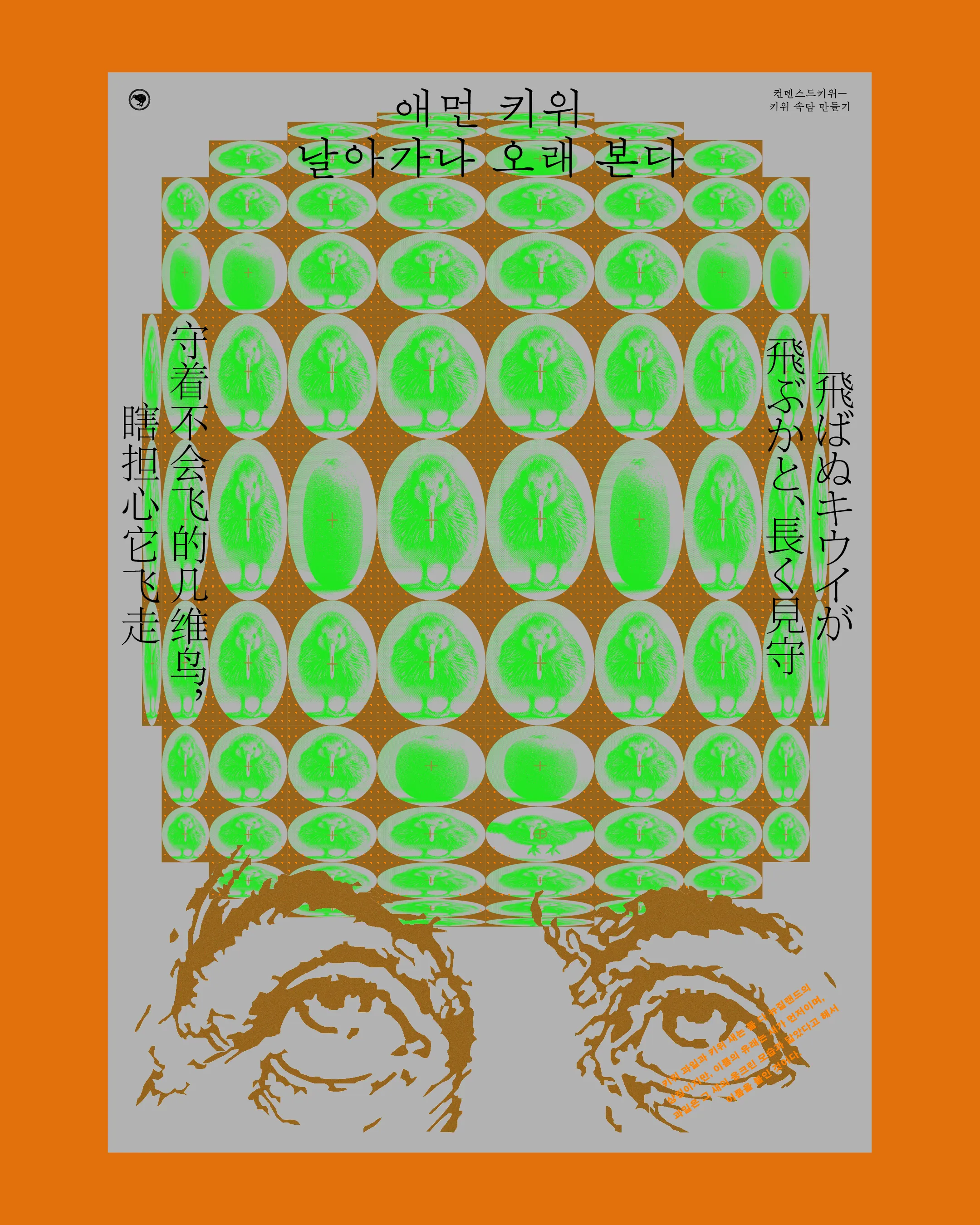
A Long Watch on a Flightless Kiwi 애먼 키위 날아가나 오래 본다

2026 · poster

BF98C351-DD26-412F-8AB9-7B748A9864C3

2026
Poster
420×594mm

Condensed Kiwi에서 진행한 《키위 속담 만들기》 워크숍에서 완성한 포스터다. 제목 '애먼 키위 날아가나 오래 본다'가 이 워크숍에서 지어낸 가짜 속담이다.

날지 못하는 키위가 혹여 날아가 사라질까, 부질없는 걱정을 붙드는 사람을 떠올렸다.

A poster completed through the Making Kiwi Proverbs workshop with Condensed Kiwi. The title — "A Long Watch on a Flightless Kiwi" — is itself a fake proverb invented in that workshop.

I thought of people who cling to useless worries: as if fretting that a flightless kiwi might suddenly fly away and vanish.

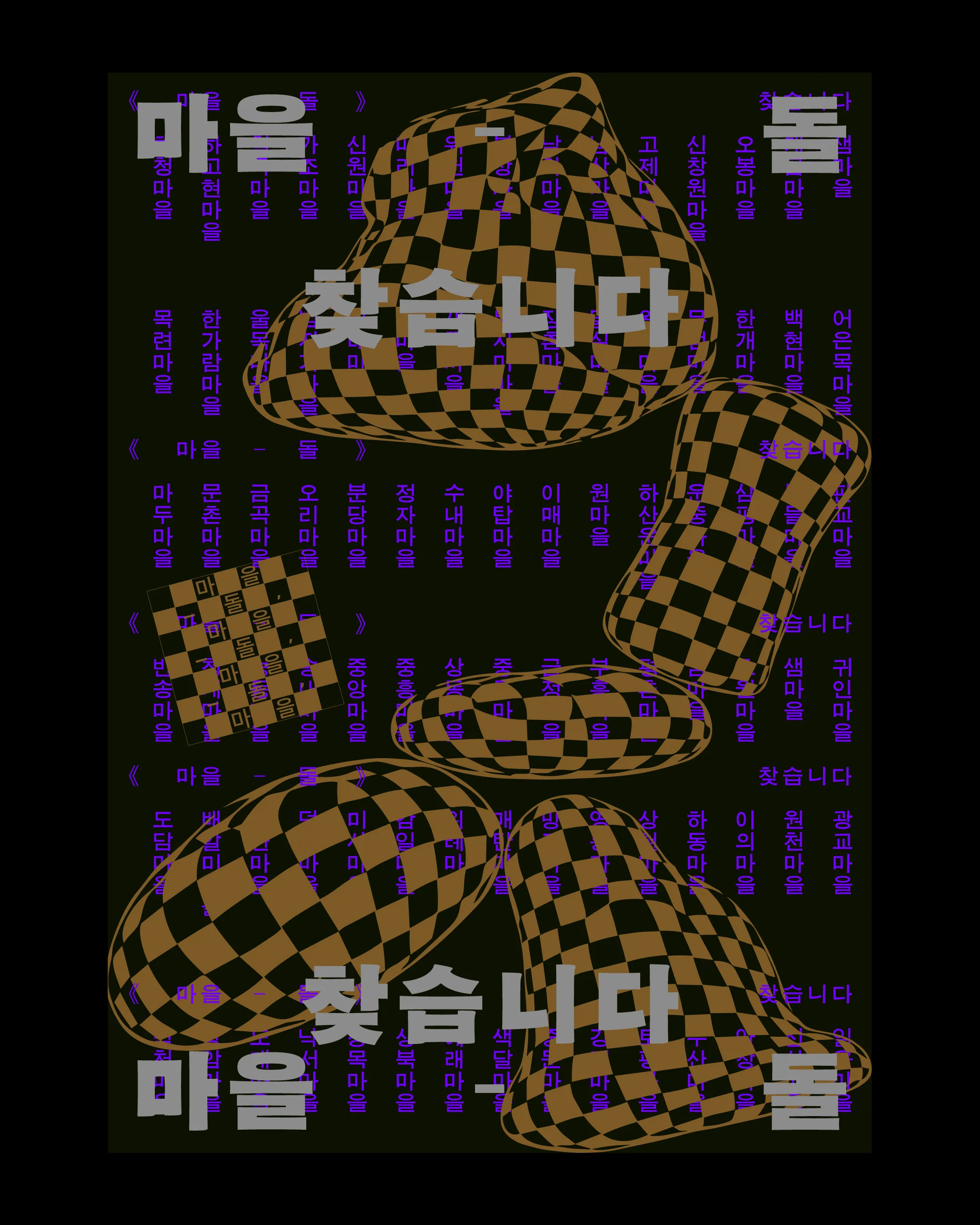
Looking for the Village Stone 마을–돌 찾습니다

2026 · poster

AD6AAF9F-A10A-46CD-8CE3-6227B92E764F

2026
Poster
420×594mm

《마을–돌》 프로젝트를 위한 마을 표지석 제보를 받기 위한 포스터이다.

‘마을–돌’은 마을 입구마다 있는 마을 표지석을 조명하는 프로젝트이다. 농촌이든 신도시이든, 대한민국 전국 어디서나 우리는 익숙하게 ‘◯◯마을’이라고 적힌 커다란 바위를 보며 익숙함을 느낀다. ‘마을–돌’은 이를 다양한 기준으로 분류·분석하고, 한국의 공동체 의식과 마을 표지석의 관계를 규명한다.

A poster calling for tips on village marker stones for the Village–Stone project.

Village–Stone is a project that spotlights the marker stones standing at the entrance of every village. Whether in the countryside or a new town, all across Korea we feel a familiar comfort at the sight of a large rock inscribed "◯◯ Village." Village–Stone classifies and analyzes them by various criteria and examines the relationship between Korea's sense of community and these village marker stones.

Hyuk’s User Guide 혁의 사용자 가이드 ヒョクのユーザーガイド

2025 · web

2025
Self Introduction

나의 잡다한 정보들을 세로쓰기 한·일 병기 타이포그라피로 웹에 구현하였다. 매 접속마다 색상과 4분할 레이아웃이 재배치되는 핸드메이드 웹.

화면은 좌상·우상·좌하·우하 4개 구획으로 나뉘며, 각 구획에 자기소개 목록, 마방진, 외부 작업 링크, 참고 출처가 배치된다. script.js는 페이지 로드 시 6개의 색상 조합 중 하나를 무작위로 골라 CSS 변수 --color-2·--color-3에 주입하고, 셔플로 네 구획의 위치를 섞어 매번 다른 배열을 만든다. 타이포그라피는 가로쓰기와 세로쓰기를 섞어 짰고, 한글과 일본어·한자를 함께 사용했다. 전반적인 웹의 그래픽은 Kohei Sugiura의 『印刷ユーザーガイド』에서 영향을 받았다.

I rendered miscellaneous information about myself on the web in vertical-writing, Korean–Japanese bilingual typography. A handmade site whose colors and four-panel layout are rearranged on every visit.

The screen is split into four quadrants — top-left, top-right, bottom-left, bottom-right — each holding a self-introduction list, a magic square, links to outside work, and reference sources. On load, script.js picks one of six color pairings at random, injects it into the CSS variables --color-2 and --color-3, and shuffles the four quadrants into a different arrangement each time. The typography mixes horizontal and vertical writing, setting Korean alongside Japanese and Chinese characters. The site's overall graphics are influenced by Kohei Sugiura's 『印刷ユーザーガイド』 (Printing User's Guide).

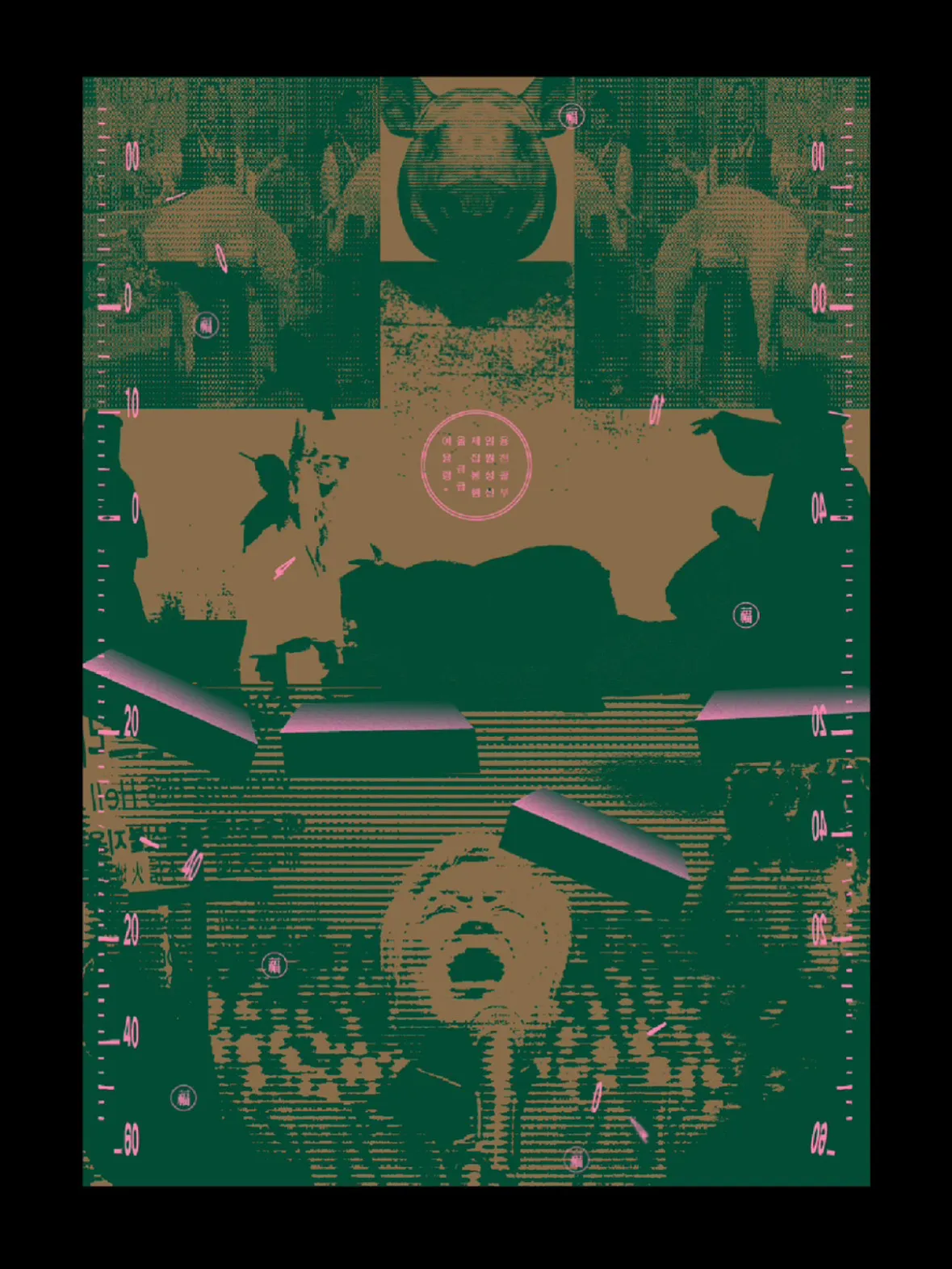
Three Sides of Hell 지옥 삼면

2025 · poster

48F4D894-ED49-443A-809A-950139996C94
72BA0558-2ADC-4287-A52B-77B5FF4FF7D1
3A4513E9-B640-4A0D-A3E3-77C9B91D7FD7

2025
Poster
420×594mm

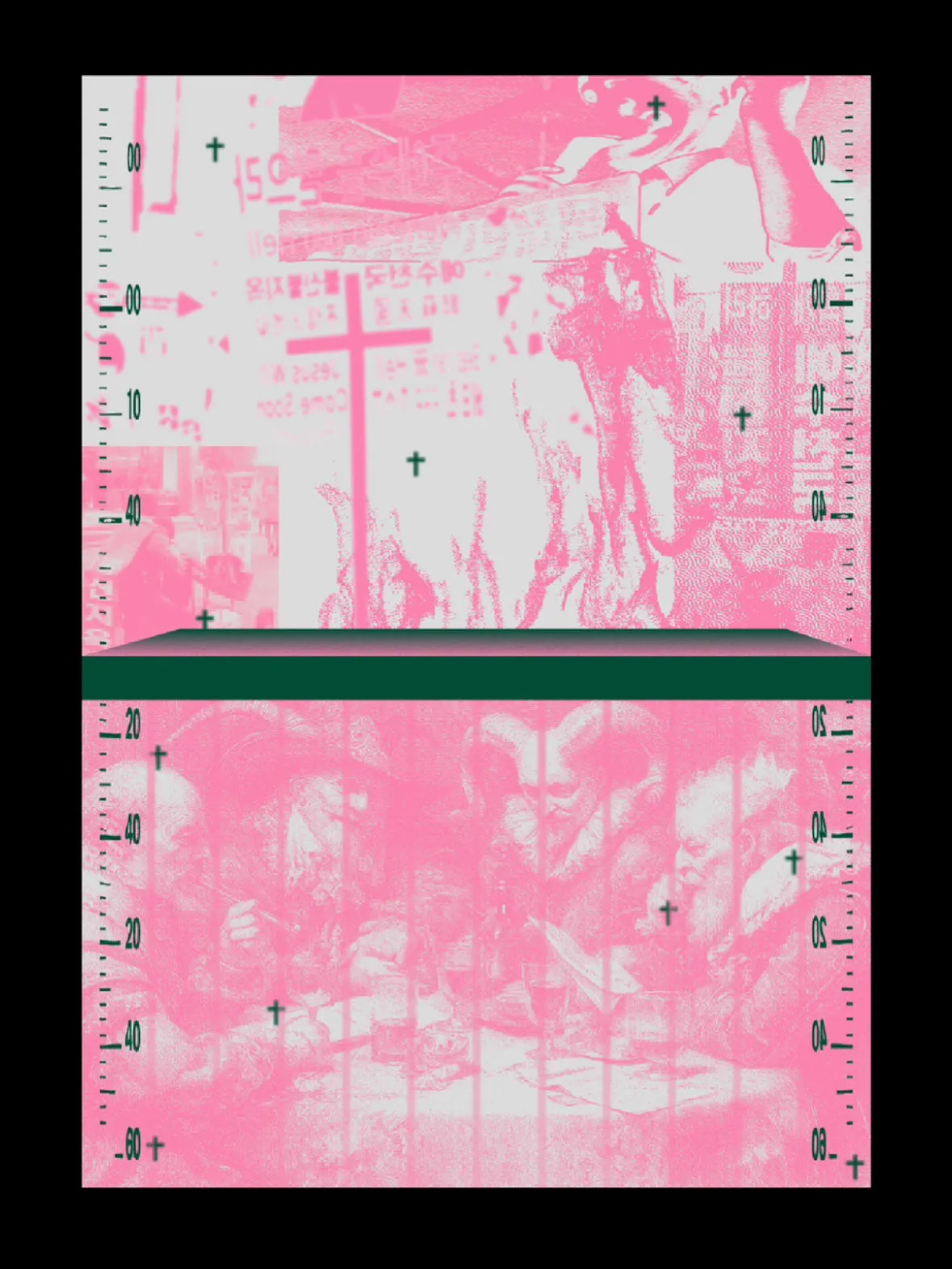
피자세이버오피스에서 @성혁이 진행한 《히드라: 세도막 형식》 워크숍에서 만든 세 점의 포스터이다. 참여자는 랜덤한 조건을 뽑아 내러티브를 가진 세 점의 연속된 이미지를 제작하였다.

ⓐ 진술: 〈지옥〉 지옥은 대개 땅 아래에 있는, 악인과 악마들이 넘치는 감옥 같은 곳으로 인식된다.

ⓑ 대조: 〈예고〉 인류 역사상 가장 큰 예고는 '종말론'이다.

ⓒ 재진술: 〈지옥+꾀〉 지상과 지옥 간의 경계는 이미 무너졌다.

These are three posters created in the Hydra: Ternary Form workshop led by @Surreal Highway at Pizza Saver Office. Participants drew random conditions and produced three sequential images forming a narrative.

ⓐ Statement: Hell Hell is commonly perceived as a prison-like place beneath the earth, overflowing with sinners and demons.

ⓑ Contrast: Prophecy The greatest foretelling in human history is "eschatology" (the doctrine of the end times).

ⓒ Restatement: Hell + Cunning The boundary between the earthly world and hell has already crumbled.

Multilingual Typography TALK for NONATAE 오직 NONATAE를 위한 다국어 타이포그래피 TALK

2025 · web

2025
Presentation

NONATAE CLUB 2기에 참여하며 다국어 타이포그라피를 소개하기 위한 프레젠테이션 웹사이트를 만들었다. 안그라픽스에서 출간된 @전가경의 『그래픽 크리틱』의 일부를 발췌하여 내용을 정리했다.

별도의 빌드 도구를 거치지 않는 핸드메이드 웹으로, 이 내용이 필요할 누군가를 위해 반영구적으로 존재한다.

구홍오직 계원예술대학교를 위한 <자주 하는 질문>에서 많은 영감을 받았다.

I created a presentation website to introduce multilingual typography as part of NONATAE CLUB Season 2. The content was compiled from excerpts of Graphic Critique by @Kay Jun, published by Ahn Graphics.

It's a handmade web page built without any separate build tools, existing semi-permanently for anyone who might need this material.

It draws heavily on inspiration from Guhong Min's Frequently Asked Questions, Only for Kaywon University of Art & Design.

The Conespiracy

2025 · web

2025
Archive

세계 각지의 트래픽 콘(traffic cone) 사진을 한곳에 모아 기록하는 단일 페이지 핸드메이드 웹이다. 길 위에 무심히 놓인 사물을 음모론적 진지함으로 수집한다. 이름은 Cone(트래픽 콘) + Conspiracy(음모)의 합성어다.

A single-page handmade website that gathers and archives photos of traffic cones from around the world — collecting these offhand objects of the street with conspiratorial seriousness. The name is a portmanteau of Cone (traffic cone) + Conspiracy.

Memodummy — hyuk ver.

2025 · web

2025
Blog

@나리가 《blank.html》(Birdcall) 워크숍에서 공유한 Memodummy 템플릿을 변형해 나의 용도에 맞게, 나만의 버전으로 포킹(forking)했다.

@혁의 Memodummy는 정제되지 않은 작업 아이디어를 모아두는 저장소로 기능한다. 별도의 빌드 도구나 프레임워크 없이 HTML·CSS·JavaScript를 직접 손본 정적 페이지이다.

I forked the Memodummy template that @nagizin shared in the blank.html workshop at Birdcall, adapting it into my own version for my own use.

@Hyuk Jang's Memodummy works as a repository for raw, unrefined work ideas. It's a static page hand-coded in HTML, CSS, and JavaScript, with no build tools or framework.

Bukcheong Saja : Secondhand Knowledge 북청사자가 됐다

2024 · poster · identity

image

2024
Poster
420×594mm

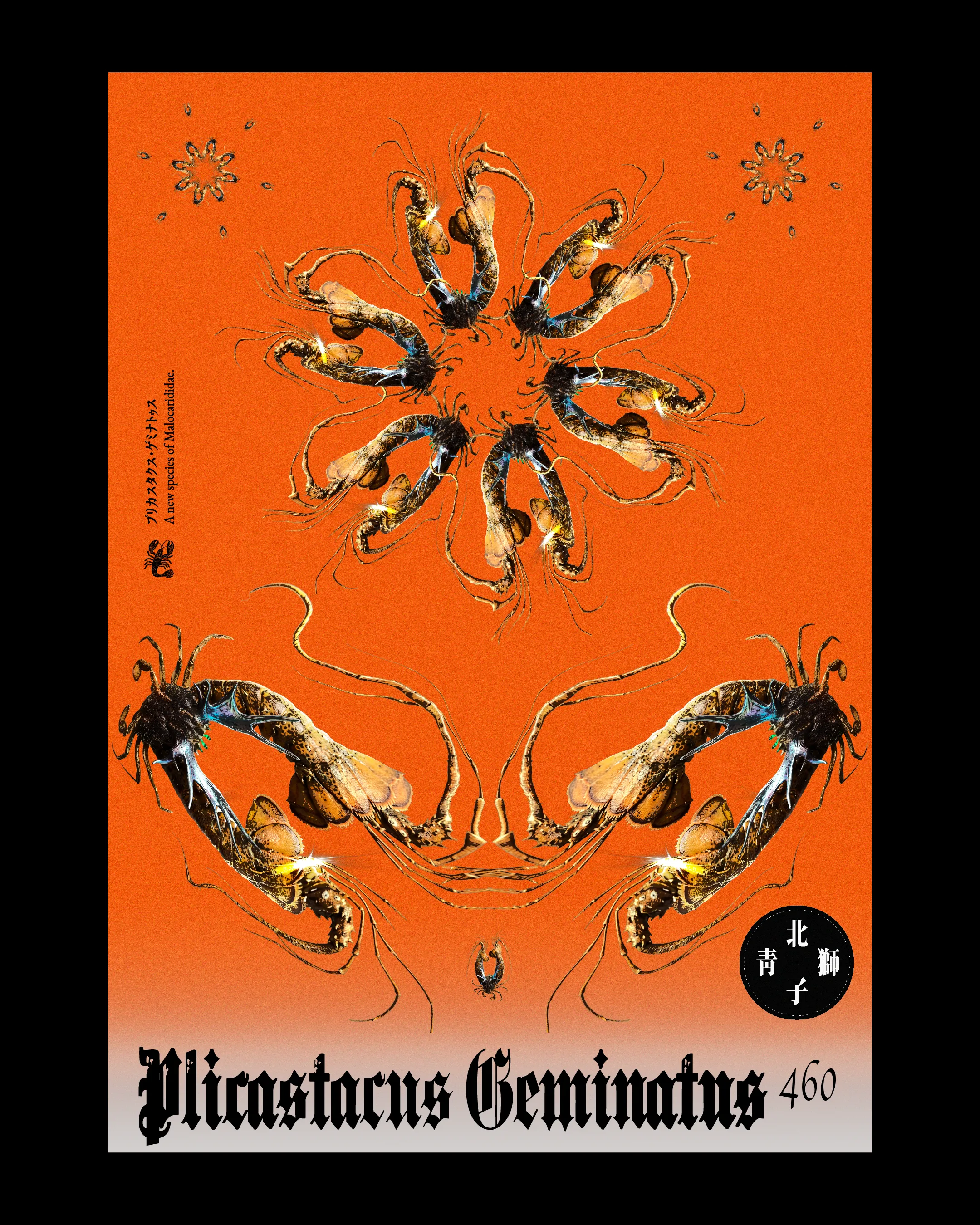
《북청사자가 됐다》는 본 적 없는 대상을 오직 말로만 듣고 재현하는 워크숍이다.

1731년, 스웨덴에서 사자를 본 적 없는 박제사가 부패한 사체와 교회의 목조 부조를 참고해 사자 박제를 만들었다. 그 결과 실제와 전혀 다른 기묘한 사자가 탄생했다. 이 이야기는 온라인 커뮤니티에 소개되었고, 그 글을 읽으며 워크숍의 구상이 시작되었다.

워크숍에서는 디테일의 밀도가 높은 단일 개체를 대상으로 삼고, 고유명사와 비유·직유 표현 없이 형태, 색, 질감, 비율, 공간적 위치 관계만으로 대상을 설명했다. 참가자들은 오직 말로만 서로의 이미지를 재현했다.

이 실험은 직접 경험하지 않은 지식(𝖲𝖾𝖼𝗈𝗇𝖽𝗁𝖺𝗇𝖽 𝖪𝗇𝗈𝗐𝗅𝖾𝖽𝗀𝖾)이 어떻게 다른 이미지를 만들어내는지 탐구한다.

워크숍의 기본 구조는 성혁이 설계했으며, 이후 이 세부 규칙을 정립해 함께 진행했다.

Becoming the Bukcheong Lion is a workshop for reproducing an unseen subject heard only through words.

In 1731, a taxidermist in Sweden who had never seen a lion built a lion mount from a decayed carcass and a wooden church relief. The result was a strange creature utterly unlike the real thing. The story spread through an online community, and reading it sparked the idea for this workshop.

The workshop took a single, detail-dense subject and described it using only form, color, texture, proportion, and spatial relationships — no proper nouns, no metaphor or simile. Participants reproduced each other's images through words alone.

The experiment explores how knowledge one hasn't directly experienced (𝖲𝖾𝖼𝗈𝗇𝖽𝗁𝖺𝗇𝖽 𝖪𝗇𝗈𝗐𝗅𝖾𝖽𝗀𝖾) gives rise to divergent images.

The basic structure was designed by @Surreal Highway; @Hyuk Jang later set the detailed rules and ran it together with him.

Fade into the dustbin of history 역사의 뒤안길로 사라져라

2024 · type

2E10245A-8C32-4893-85A0-5BCA416876DD

2024
Lettering

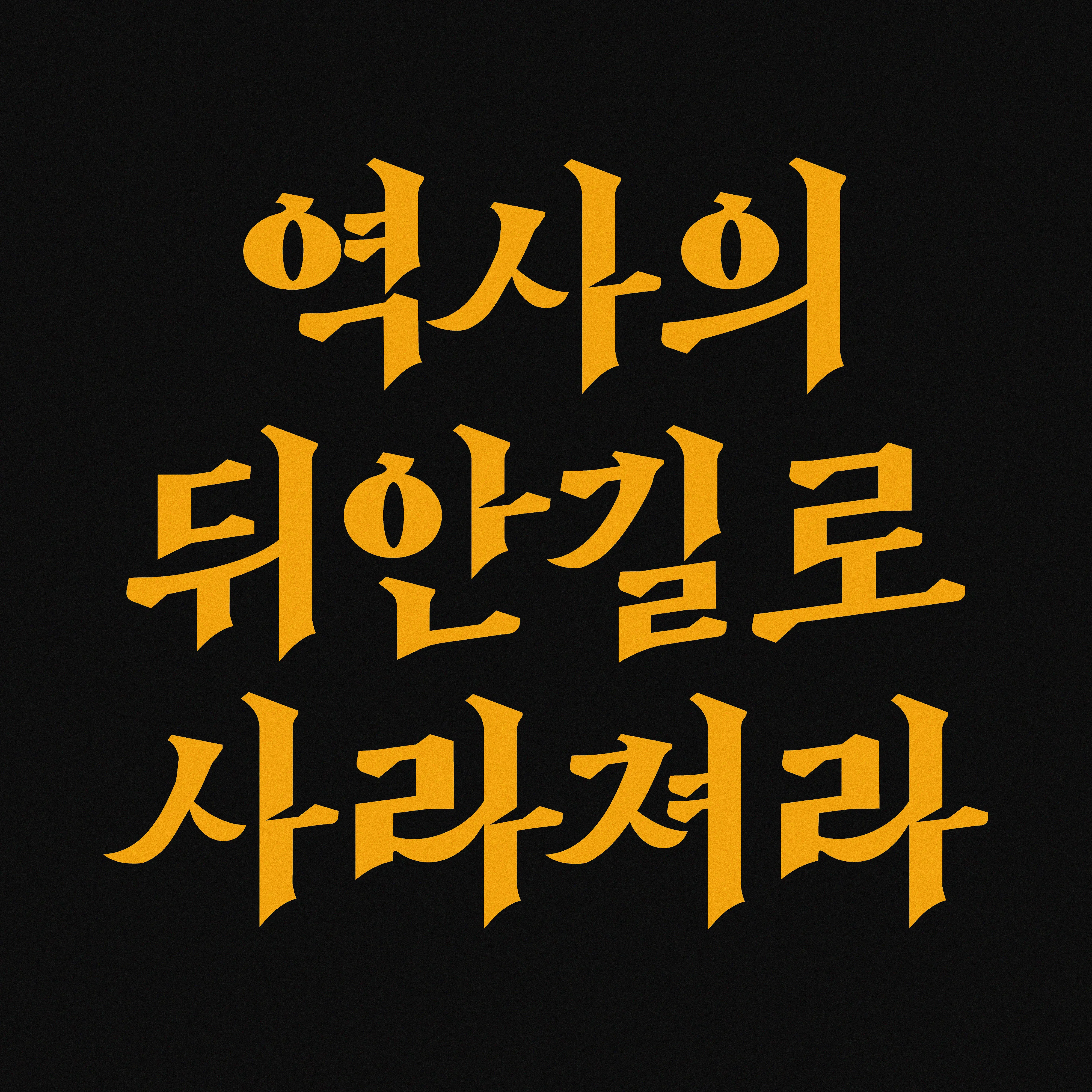
《꼴의 힘》에 참여한 레터링 작업이다.

《꼴의 힘》은 12·3 비상계엄에 대한 내용과 그에 대한 책임을 묻는 표어·단어·문장을 디자인하고 파일과 사용권을 무료로 배부하는 프로젝트이다.

A lettering piece made for The Power of Form.

The Power of Form is a project that designs slogans, words, and sentences addressing the December 3rd martial law and the accountability for it, then distributes the files and usage rights for free.

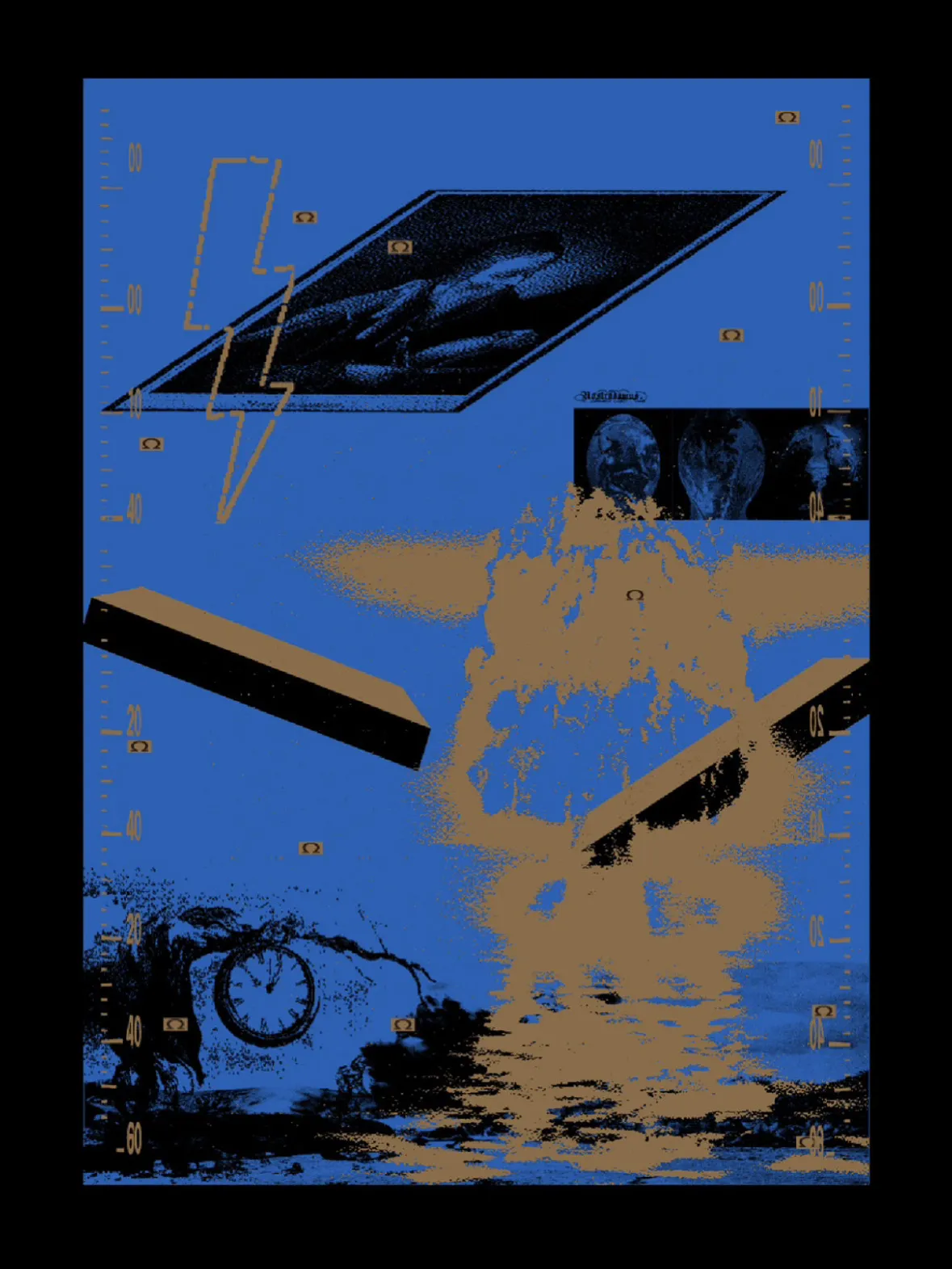
Superpower Release 초능력 해방

2024 · poster · identity

E8D0B079-1A45-47AE-8752-9A63364AAF71
03C7CB9D-58BE-4403-AEE5-B5554F308823

2024
Poster
420×594mm

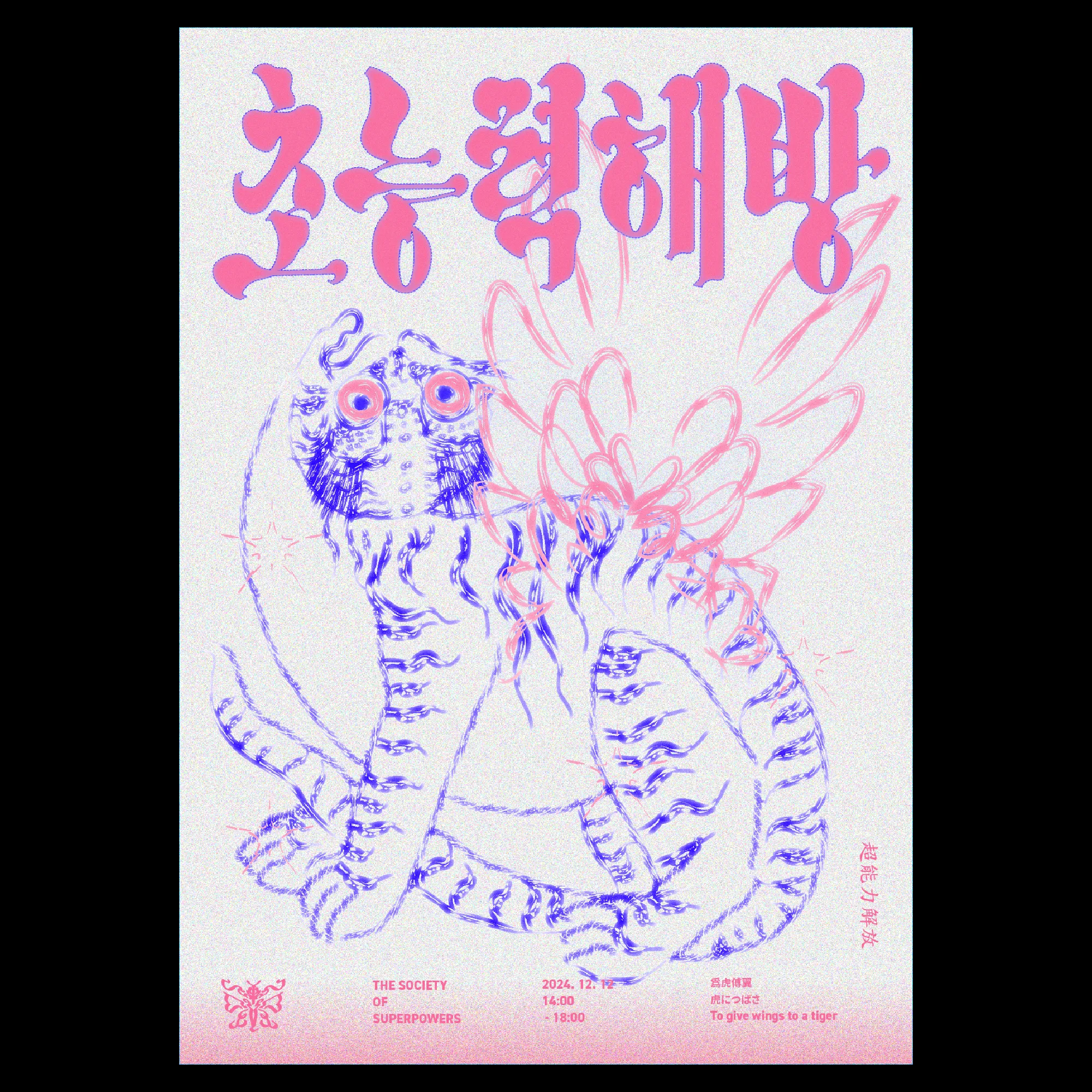
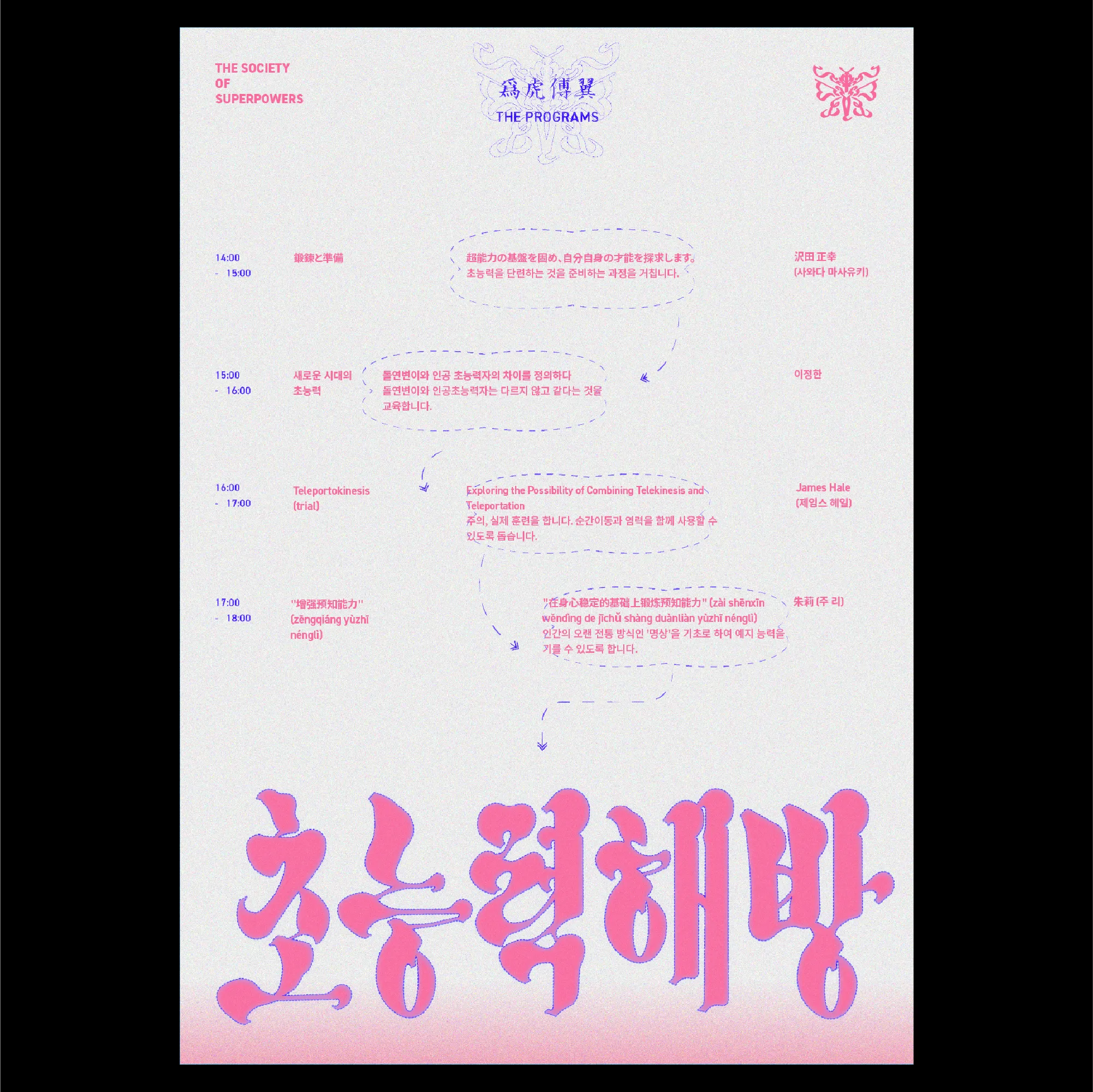
초능력을 인간이 받아들인 세계, 가상의 '초능력 협회(The Society of Superpowers)'를 설정하고 그 아이덴티티를 만들었다. @해진이 기획과 일러스트를, @혁이 레터링과 포스터를 맡았다.

비주얼의 모티브는 위호부익(爲虎傅翼), '호랑이에게 날개를 달아준다'는 말이었다. 흔히 악인이나 강자에게 힘을 더 실어준다는 부정적 뜻으로 쓰이지만, 과연 그렇게만 읽어야 하는가? — 그 물음에서 시작했다.

보다 더 강해지고 싶은 마음이 과연 오직 위선적인 마음일지 질문을 던지고 싶었다.

A world where humanity has embraced superpowers — I set up a fictional "Society of Superpowers" and built its identity. @Haejin Lee led the concept and illustration, while @Hyuk Jang handled the lettering and posters.

The visual motif came from an old phrase, 爲虎傅翼 (wihobuik), "to give wings to a tiger." It usually carries a negative sense — lending more power to a villain or a strongman — but must it be read only that way? That question was the starting point.

I wanted to ask whether the wish to grow stronger is really nothing more than hypocrisy.

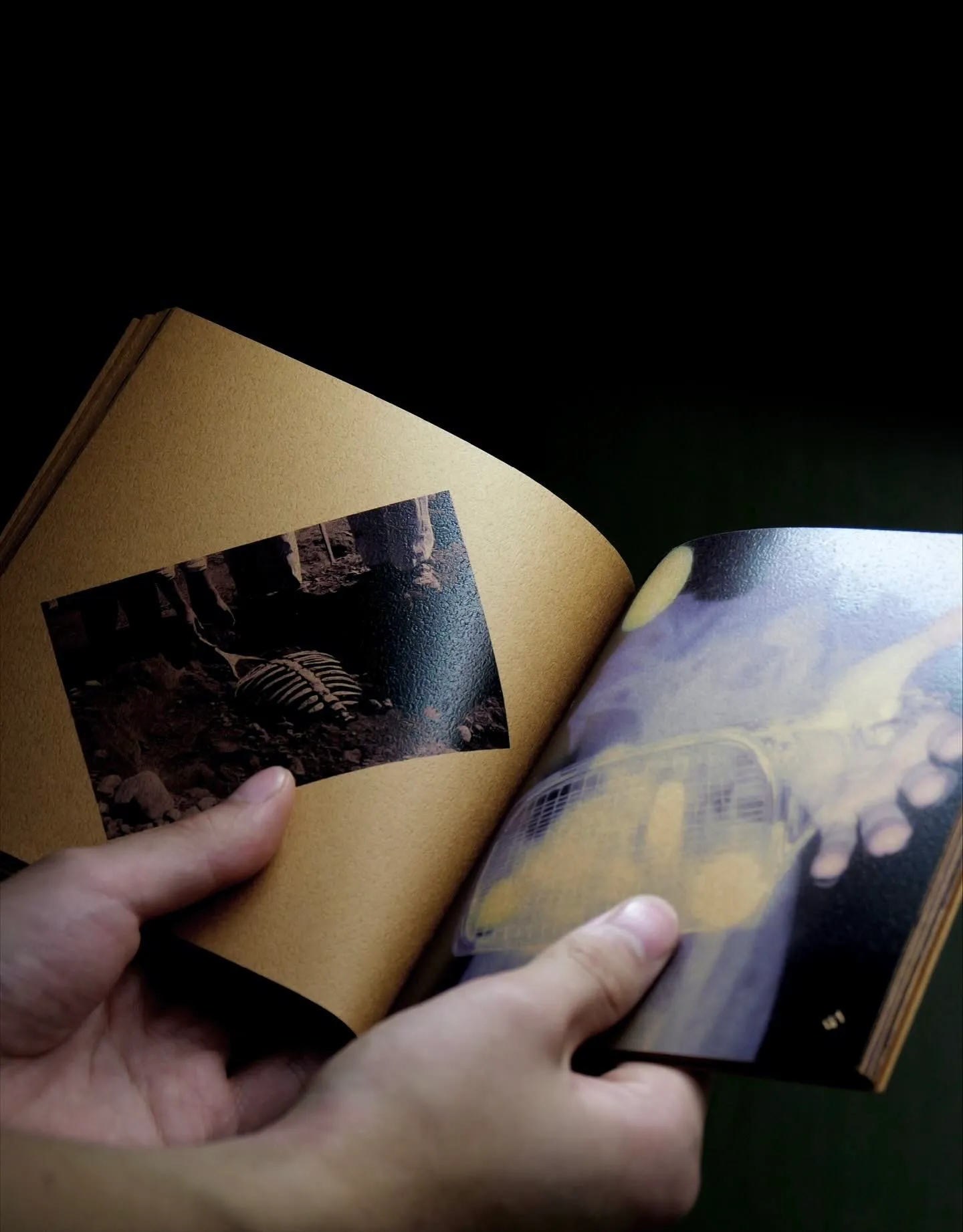
The way to make (fake) Superstitions[Book] 가짜 미신을 만드는 방법[Book]

2024 · editorial

D2B4EFB8-83E9-4D43-82DE-83185E2C382A
CCE30317-498F-4BD1-B667-0EFC1ED486AB
0A42D9D3-610E-4D26-955E-A74612B2DEF4
5A6B5973-E3FA-4EA1-9D9D-42646BC0AA70

2024
Book
140×205mm, 56p, perfect binding

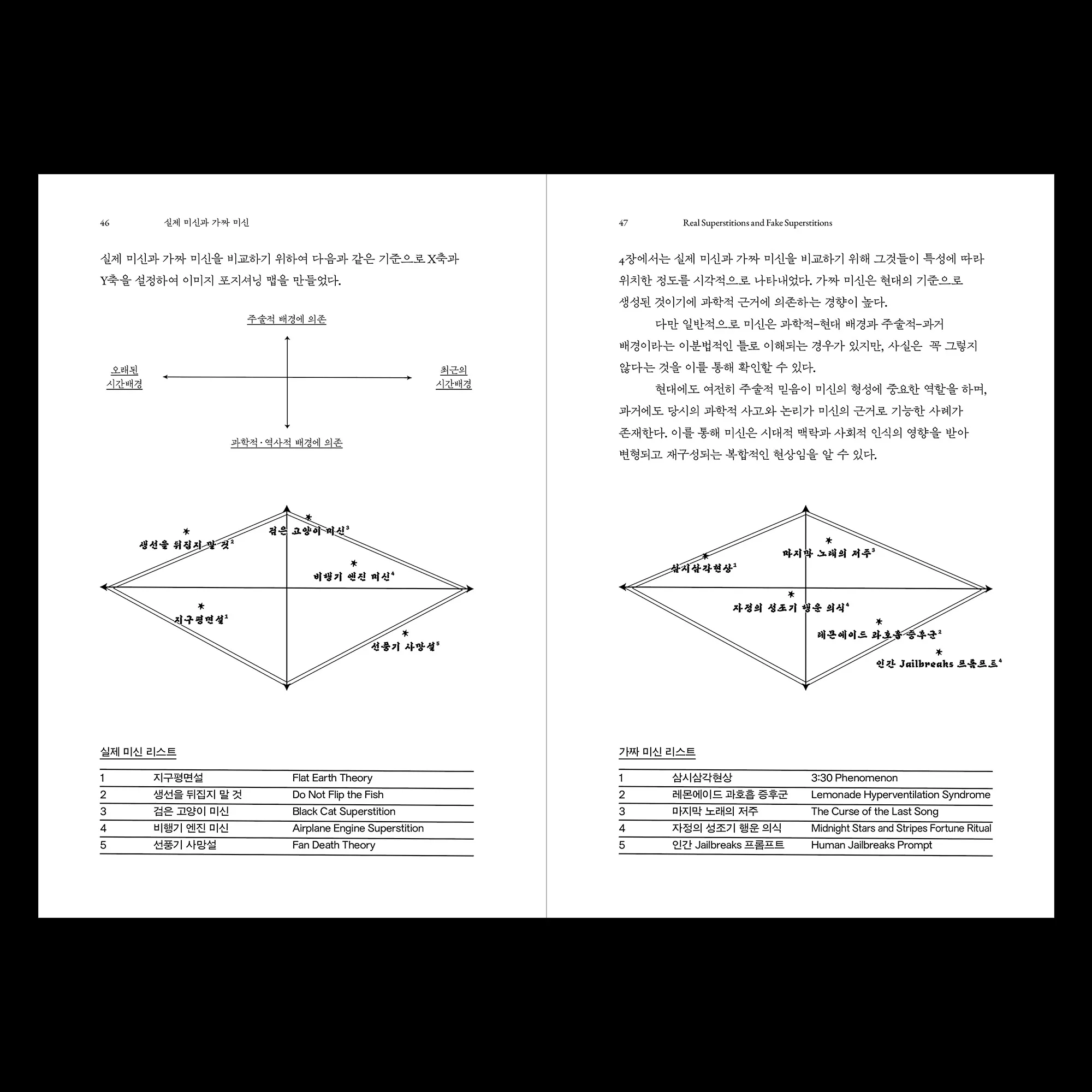
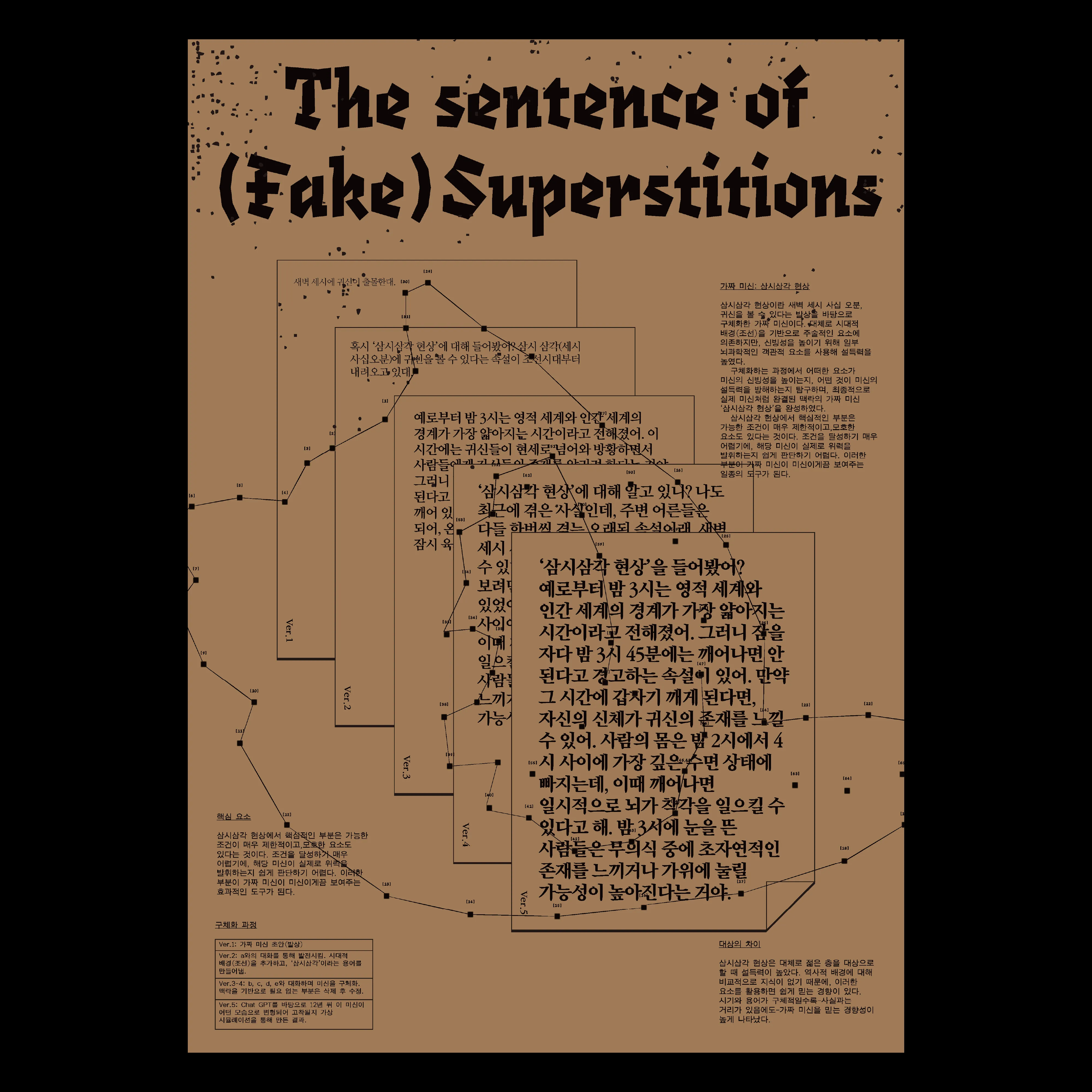
실제 미신을 분해해 그것을 이루는 요소를 분석한 뒤, 같은 문법으로 가짜 미신을 지어내고 — 시간이 흐르면 그것이 어떻게 변질될지 가상으로 시뮬레이션한 책이다.

1장. 실제 미신을 분석하기
2장. 가짜 미신을 만드는 방법
3장. 가짜 미신 리스트
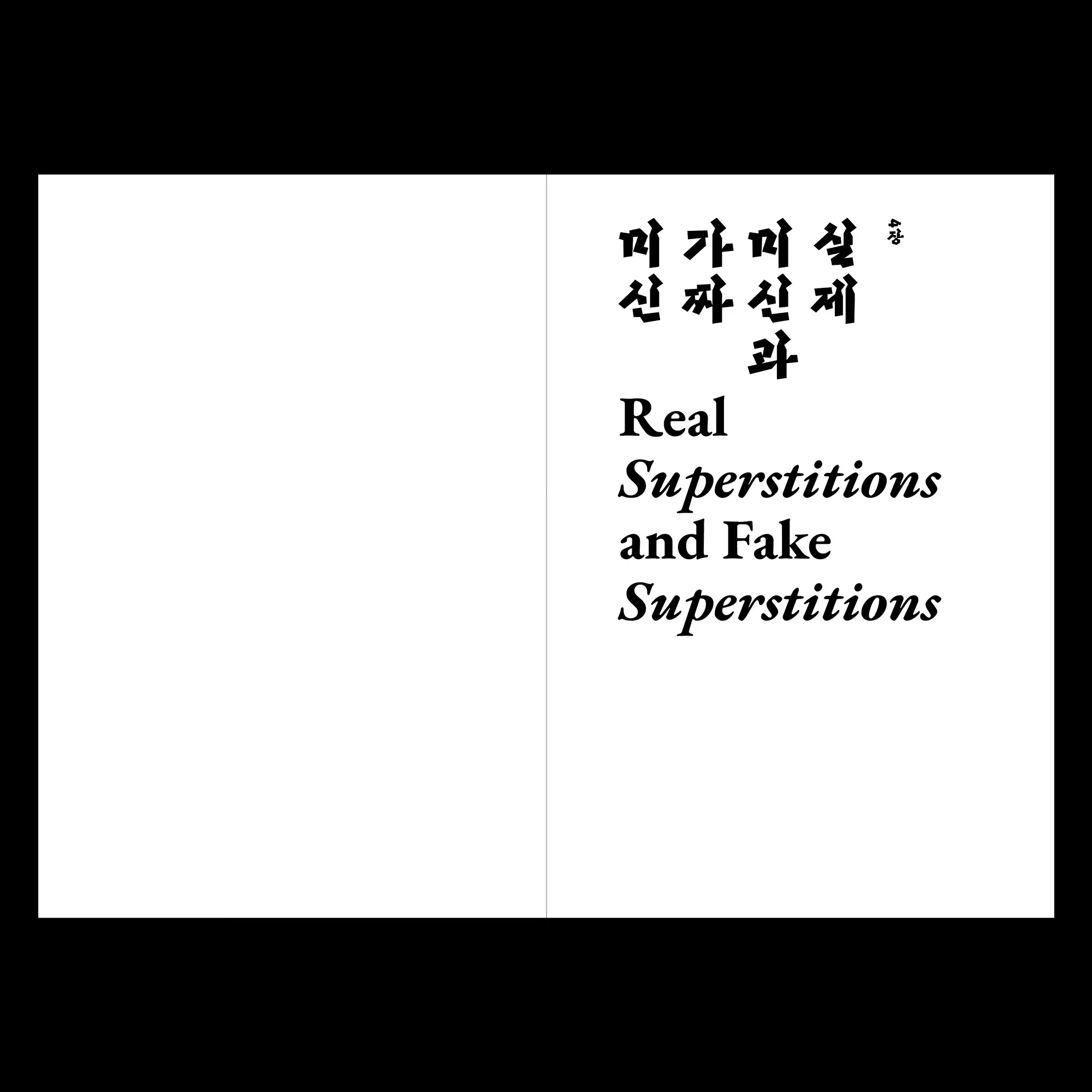
4장. 실제 미신과 가짜 미신

A book that breaks real superstitions down into their constituent elements, then uses the same grammar to invent fake ones — simulating how they might mutate over time.

Chapter 1. Analyzing Real Superstitions
Chapter 2. How to Create Fake Superstitions
Chapter 3. A List of Fake Superstitions
Chapter 4. Real Superstitions and Fake Superstitions

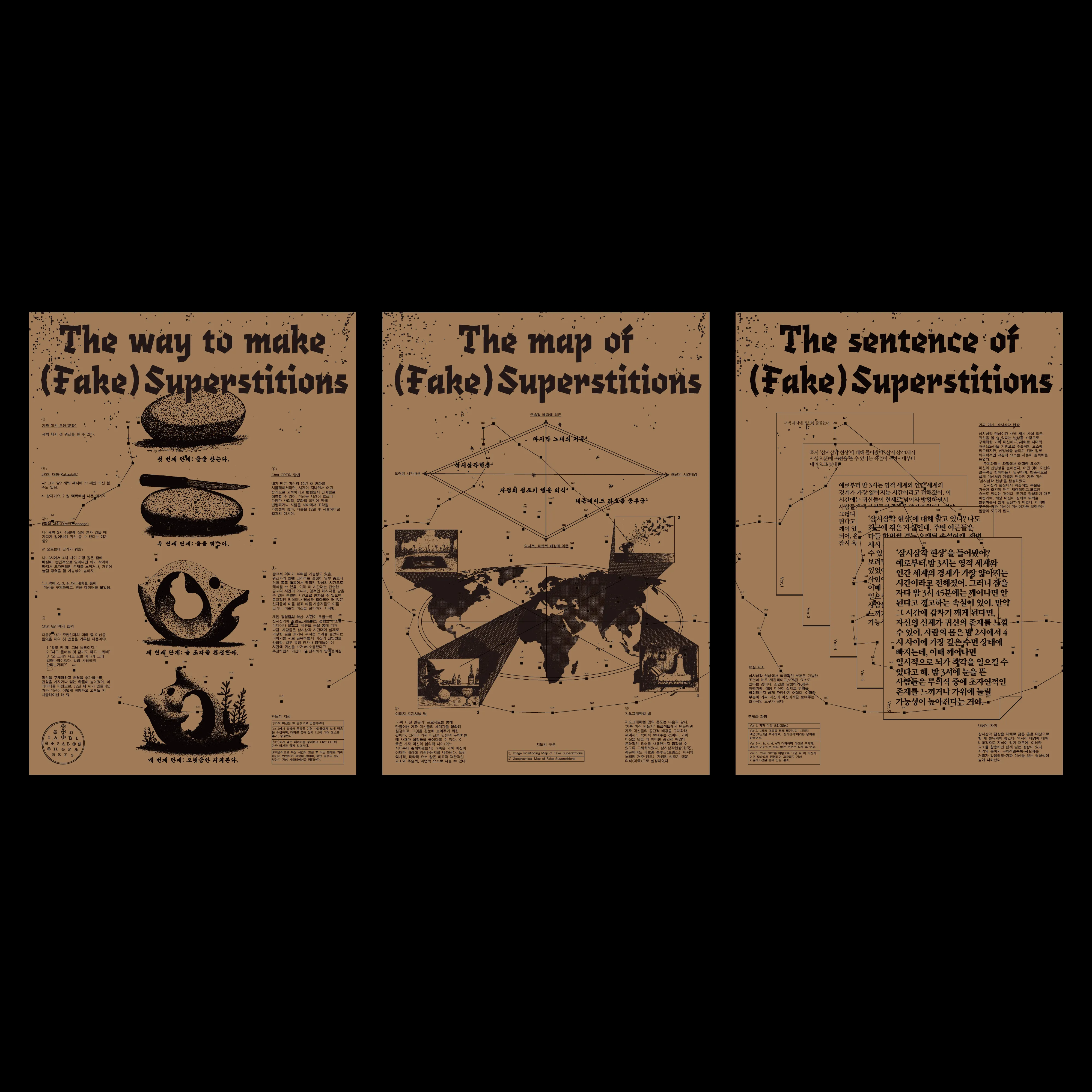
The way to make (fake) Superstitions[Poster] 가짜 미신을 만드는 방법[Poster]

2024 · poster

AD2241D1-FD21-4B09-A784-0CDD1285AC5A
1E096FE1-DB78-4B65-A205-08FD8E525BA5
3A57DEA6-F4E3-4673-AC76-69DE46EC1C54
6A58586F-3842-4D3A-8861-8EB70713CA01

2024
420×594mm

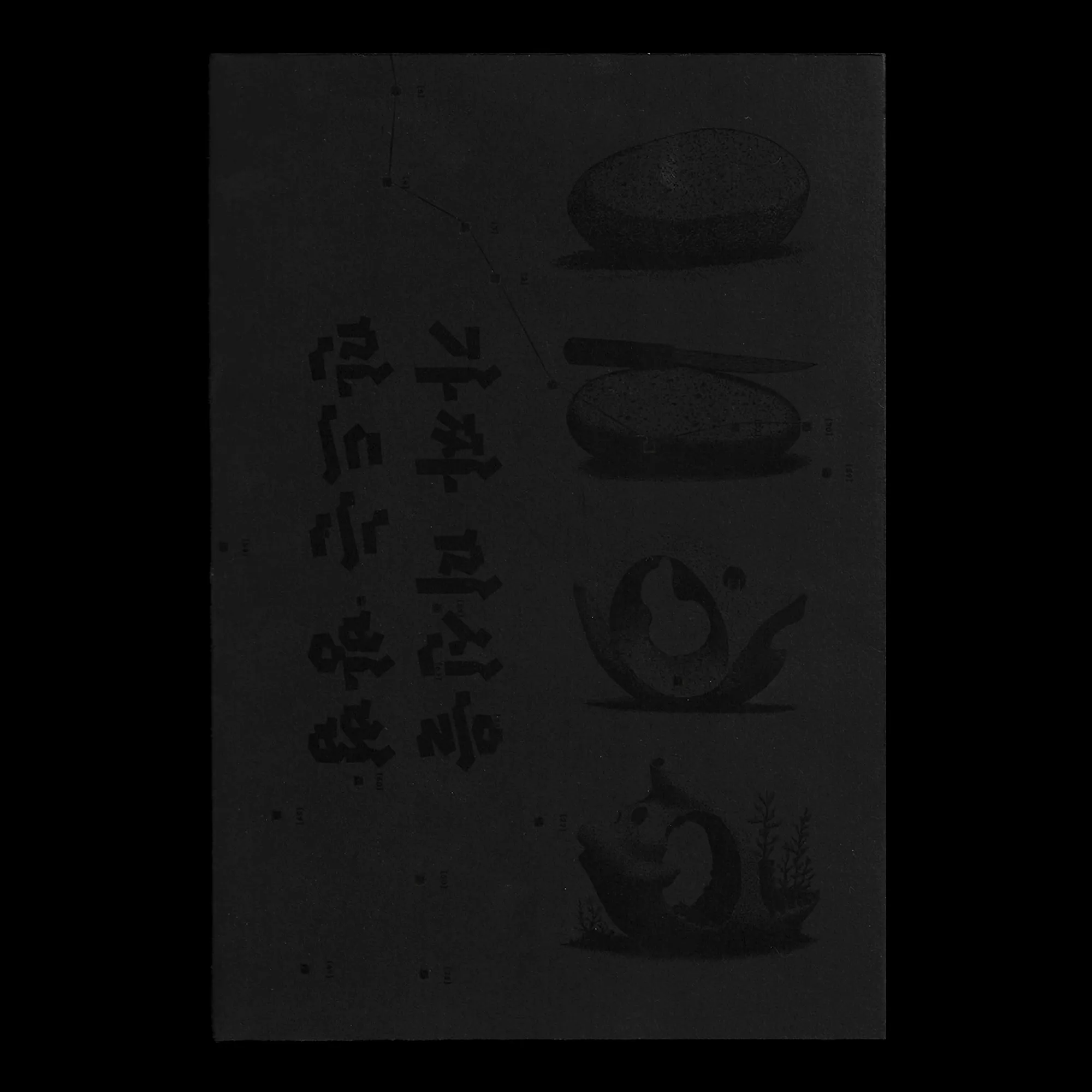
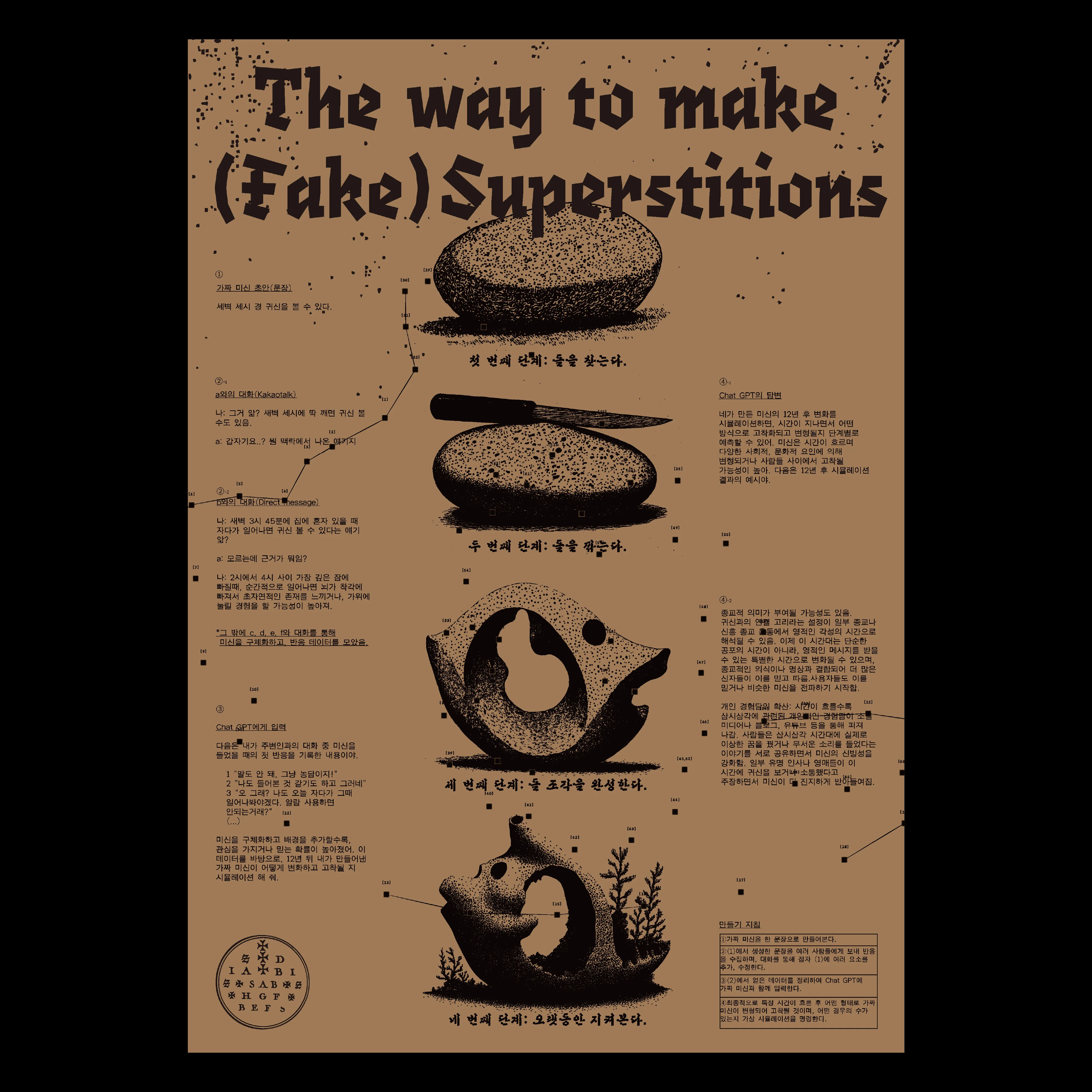
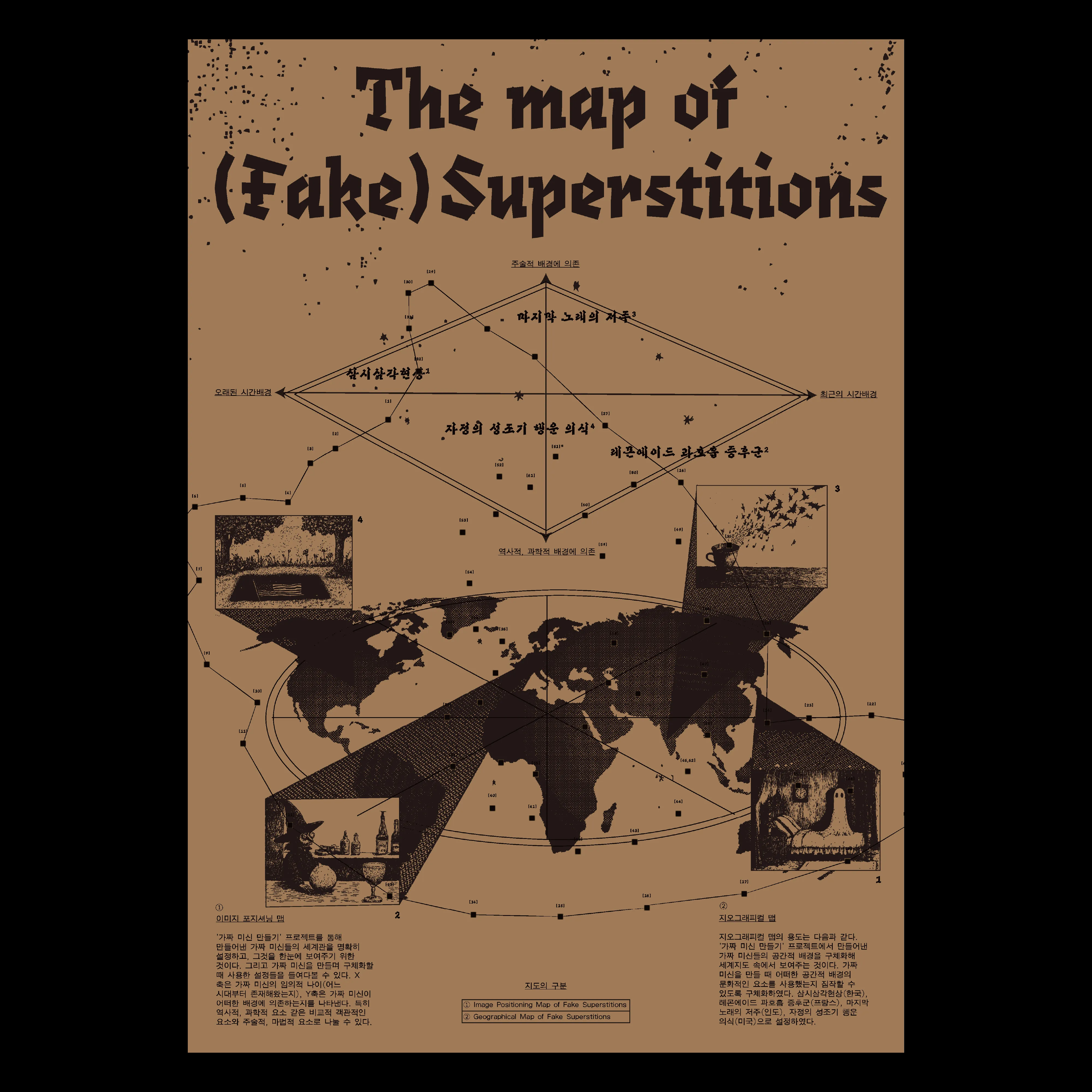
《가짜 미신을 만드는 방법》 프로젝트의 포스터다. 실제 미신을 분해해 얻은 요소로 가짜 미신을 지어내고, 이 활동의 과정을 세 장의 포스터로 표현했다.

세 장의 포스터에서 미신은 밤하늘로 은유된다. 별자리를 점선으로 잇는 성도(星圖)를 뼈대로 삼아, 겹겹이 포개진 텍스트 패널이 가짜 미신의 생성과 변형 과정을 따라간다.

Posters for the project The Way to Make (Fake) Superstitions. Real superstitions are broken into their elements, fake ones are invented from them, and the whole process is laid out across three posters.

Across the three sheets, superstition is figured as the night sky. Built on a star chart — constellations joined by dotted lines — layered panels of text follow the making and warping of these fabricated beliefs.

Dream Excavater 몽중발굴

2024 · editorial

54FAF80B-D9DD-454C-86A6-049A7D9342C0

2024
Book
130×130mm, 80page, perfect binding

AI는 추상적인 개념을 구체화할 수 있는 도구이다.

이 작업은 생성형 AI의 Style Reference 기능을 활용하여, 뼈와 엑스레이 이미지를 가중치 0.5에서 2.0까지 순차적으로 참조하며 진행된다.

이 과정을 통해 임의의 층위를 만들고, 그 층위를 하나씩 발굴하듯 시각적 탐사를 이어간다.

발굴은 의식적으로 ‘데자뷔(Déjà vu)’의 순간을 메타적으로 인지하는 행위이며, 생성형 AI는 이 인식 과정을 보조하는 일종의 발굴 도구로 기능한다.

작업의 출발점은 메모장에 기록된 꿈의 단편들이다.
파편적인 키워드 중심의 꿈 기록에서 핵심어를 추출해 1차 프롬프트를 구성한다.
이후 다음의 단계를 반복한다.

① 1차 이미지 생성
② 연상 키워드 추출
③ 2차 이미지 생성
④ 연상 키워드 추출 및 수정
⑤ 3, 4차 이미지 생성
⑥ 연상 키워드 추출 및 수정

이 과정을 가능한 한 데자뷔에 가장 근접한 순간까지 반복하며, 무의식의 층위를 탐색한다.

모든 과정은 꿈의 상징을 해석한 칼 구스타프 융(Carl Gustav Jung)의 사상에 기반하여,
생성형 AI는 이때 단순한 생성 도구가 아니라, 무의식과 의식 사이를 매개하는 일종의 고고학적 장치로 작동한다.

AI is a tool for giving form to abstract concepts.

This work uses the Style Reference feature of generative AI, referencing bone and X-ray images in sequence at weights from 0.5 to 2.0.

Through this it builds up arbitrary strata and carries out a visual excavation, unearthing them one layer at a time.

The excavation is the act of consciously, meta-cognitively catching the moment of "deja vu"; here generative AI functions as a kind of excavation tool that aids that recognition.

The starting point is fragments of dreams jotted in a notepad. Keywords are pulled from these scattered, keyword-centered dream notes to build a first prompt. Then the following steps repeat:

① first image generation
② drawing out associated keywords
③ second image generation
④ drawing out and revising associated keywords
⑤ third and fourth image generation
⑥ drawing out and revising associated keywords

The cycle repeats as close as possible to the moment of deja vu, probing the strata of the unconscious.

The whole process rests on the thought of Carl Gustav Jung, who read the symbols of dreams; here generative AI is not a mere generation tool but a kind of archaeological device mediating between the unconscious and the conscious.

Lettering Study 레터링 스터디

2024 · poster

0AB322F6-C156-467D-8DBE-B6FDD235F4BB

2024
Poster
420×594mm

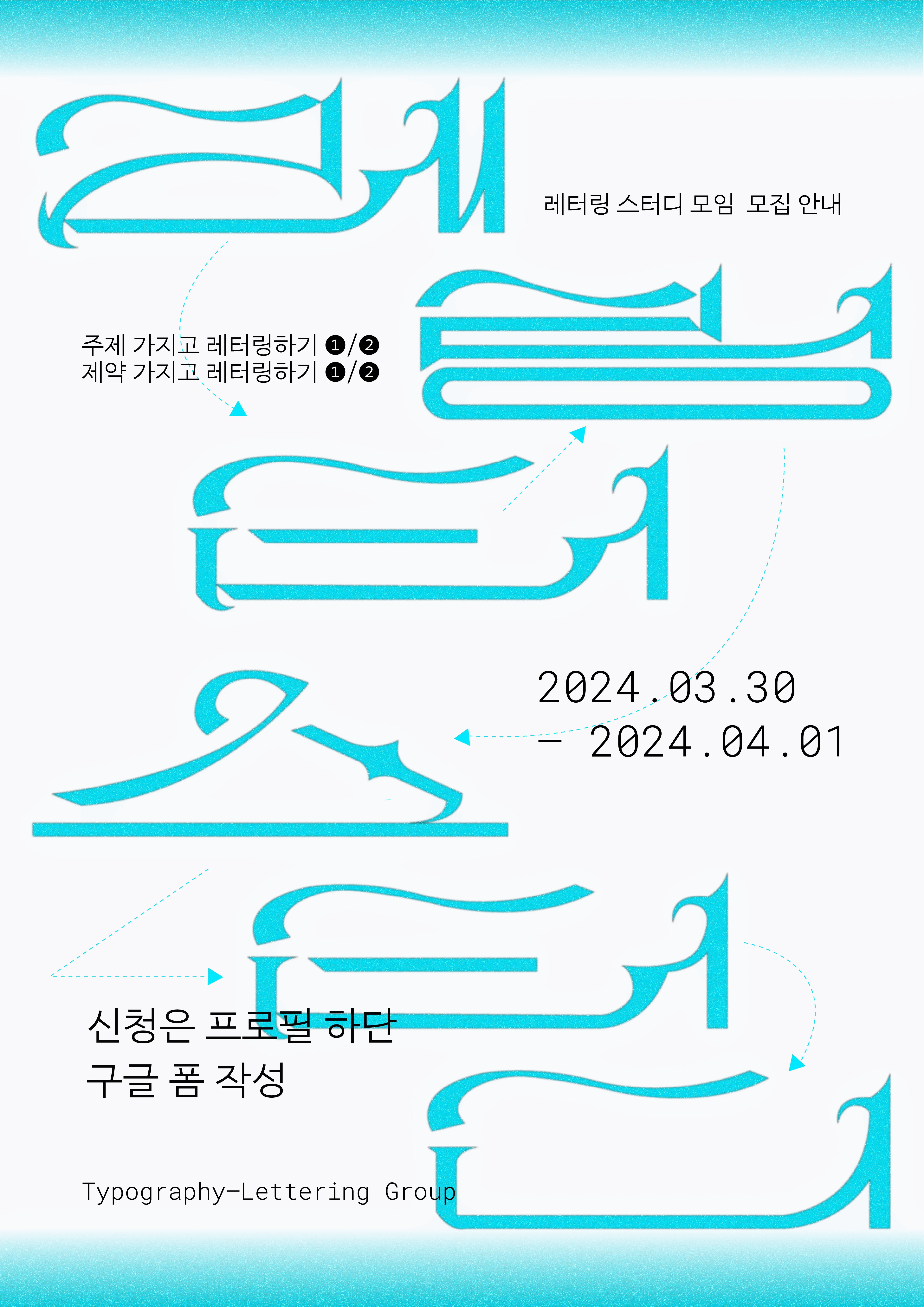
레터링 스터디 모임의 모집 포스터다. '주제를 가지고', '제약을 가지고' 글자를 그리는 두 갈래 과제로 이뤄진 스터디(2024.03.30–04.01)를 알린다.

흐르듯 변형된 청록색 한글 레터링이 화살표 동선을 타고 화면을 가로지르며, 레터링이라는 행위 자체를 포스터의 주된 형상으로 삼았다.

A recruitment poster for a lettering study group. It announces a study (March 30 – April 1, 2024) built from two tracks — drawing letters "with a theme" and "with a constraint."

Fluid, warped cyan Hangul lettering streams across the sheet along arrow-like paths, making the act of lettering itself the poster's central image.

Youngone 영원

2023 · type

AF40D51F-6718-4163-9FF0-B000BB75F2E7
E985839A-81EE-4F00-AC20-5DD316F2F7B1
DE0A5FD0-43EE-4770-9992-4B53455D2DA3

2023
Typeface

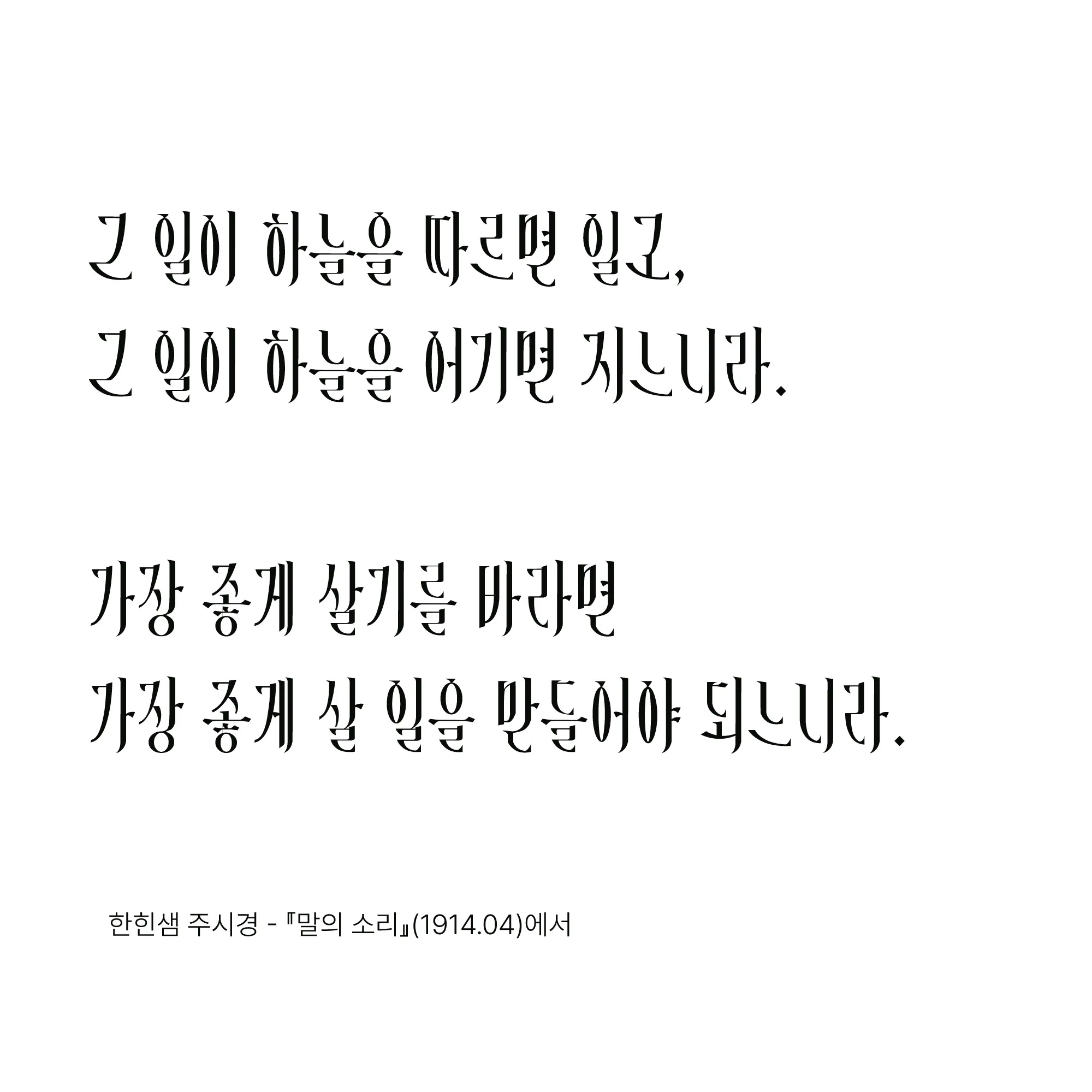
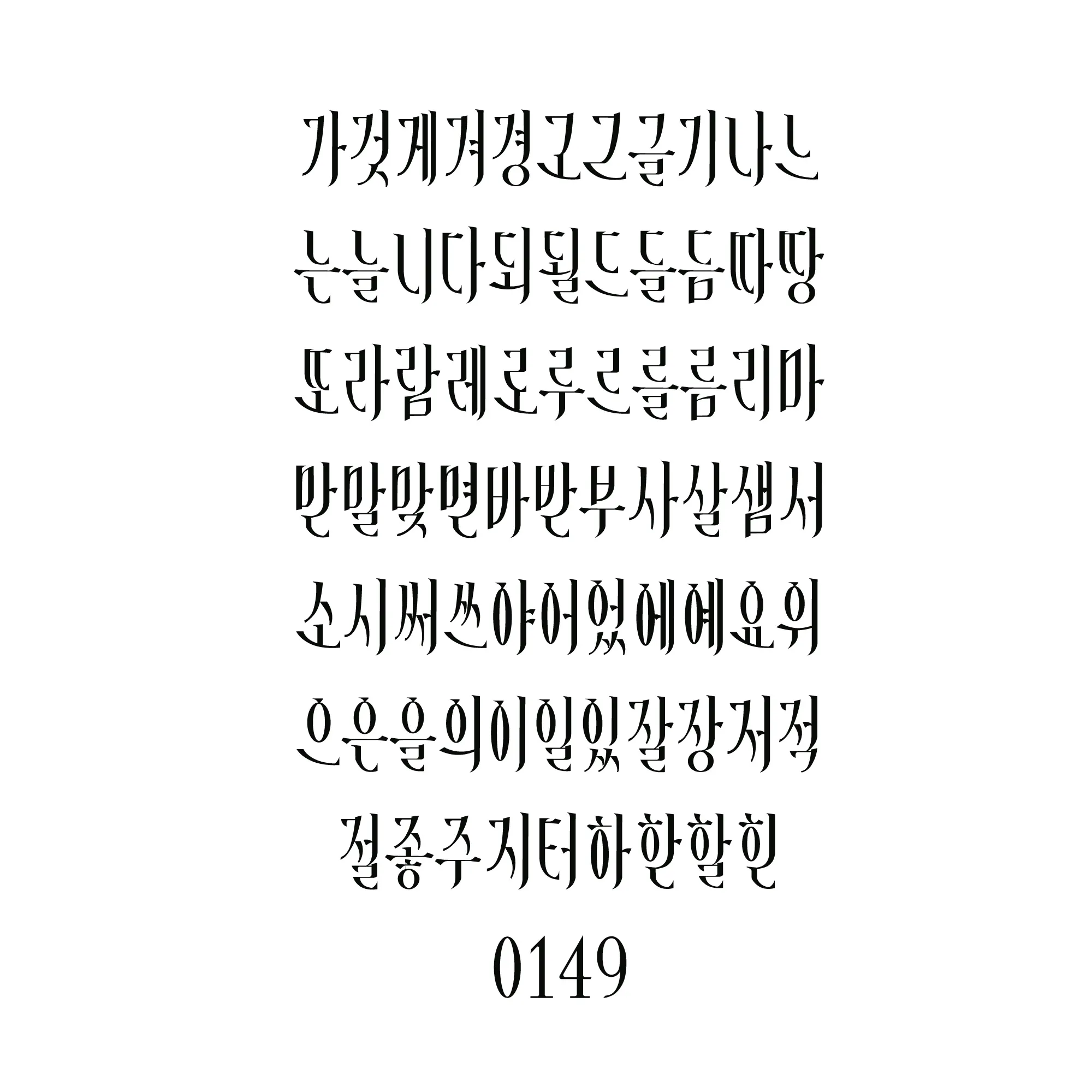
영원체는 중성과 종성의 유려한 획 이음이 특징인 제목용 서체이다.

예문은 한힌샘 주시경의 『말의 소리』(1914.04) 발췌문이다.

사단법인 세종대왕기념사업회가 주최한 제31회 한글글꼴공모전에서 아름상을 수상했다.

Youngone is a display typeface marked by the fluid stroke connections between its medial and final consonants.

The specimen text is an excerpt from Han Hin-saem Ju Sigyeong's The Sound of Speech (April 1914).

It received the Areum Award at the 31st Hangeul Typeface Competition, hosted by the King Sejong the Great Memorial Society.

built2026.07.03 22:01:46KST now2026.07.03 22:01:46KST

indieweb webring